Forward Head Posture: 5 Exercises, a 2-Minute Wall Test and a Longer-Looking Neck
Check your head position in two minutes, learn five exercises with form cues, fix the screen habits that matter most, and see what stacking your head does for your neck and jawline.

On this page
- What is forward head posture?
- Does posture change how you look?
- The 2-minute wall test
- 5 forward head posture exercises
- Daily habits: phone, screen and desk setup
- Does forward head posture cause a double chin?
- How to make your neck look longer
- How long does it take to fix forward head posture?
- When to see a physical therapist
Forward head posture means your head sits in front of your shoulders, not stacked over them. Exercise programs for the neck, shoulder blades and upper back improved it in randomized trials, with changes measured after four to six weeks. Stack your head and your neck looks longer and the line under your jaw cleaner, instantly.
On social media this is the swan neck: a long, elegant neck from training one muscle between your shoulder blades. The idea is sound. The lower trapezius draws your shoulder blades down, and when your shoulders settle and your head stacks, more of your neck shows.
This article covers a two-minute self-check, five exercises with form cues, the screen habits that matter as much as any exercise, and what posture does for how you look.
What is forward head posture?
Forward head posture is when your ear sits in front of your shoulder, seen from the side, instead of roughly above it. It often comes with rounded shoulders and a rounded upper back. A 2019 review called it the most common posture fault of the neck, and adults with neck pain tend to have more of it.
Researchers measure it with the craniovertebral angle: the angle between a horizontal line through the bony bump at the base of your neck and a line from that bump to your ear. The further forward your head, the smaller the angle. One 2025 trial enrolled students whose angle measured under 50 degrees (Argyrou et al., 2025).
Ear over shoulder
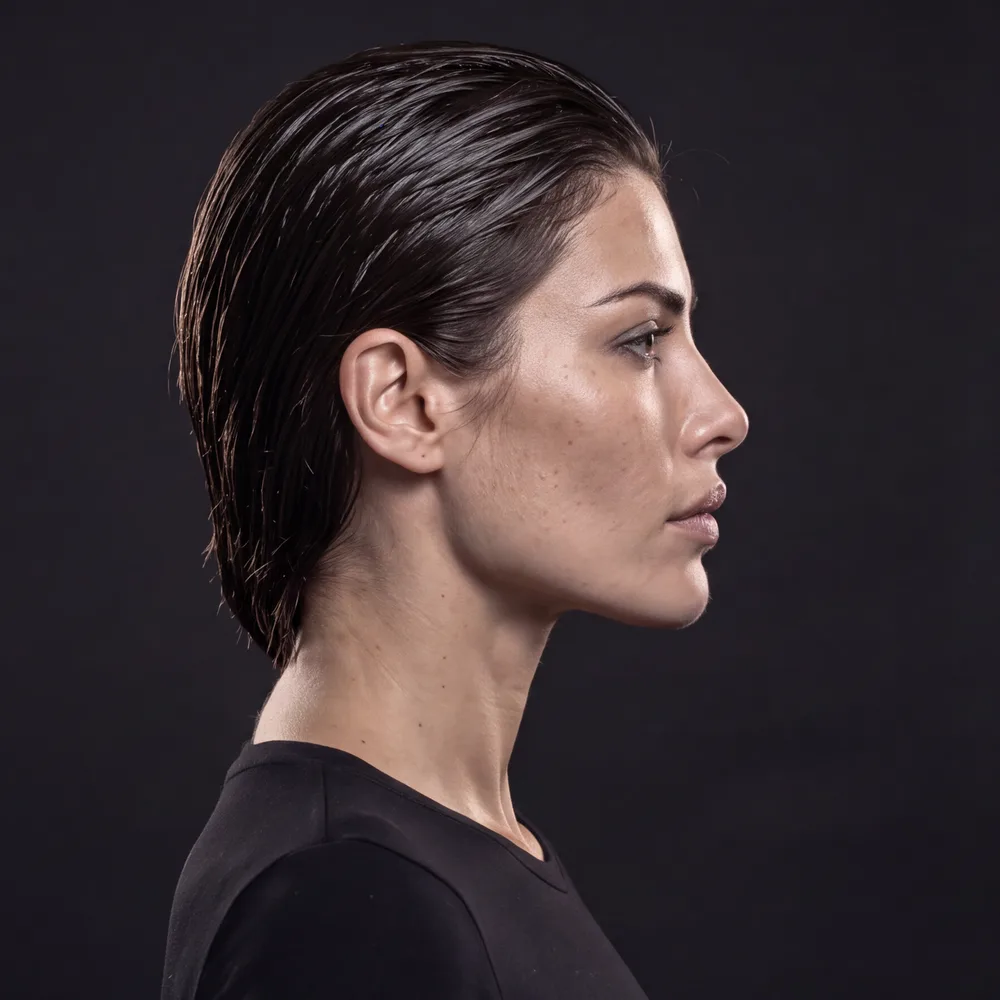
Larger angle
Head forward

Smaller angle
- C7 The bony bump at the base of the neck
- Tragus The small flap in front of the ear canal
- Craniovertebral angle Between the horizontal through C7 and the line to the ear
A 2025 trial enrolled people whose angle was under 50°.
Phones are the usual suspect. A review of 12 studies found that using a smartphone increased head flexion and forward head shift and made the upper trapezius and neck extensor muscles work harder; sitting shifted the head-neck angle more than standing (Eitivipart et al., 2018). Laptops, long drives and reading in bed add up the same way.
Posture and neck pain travel together. In a meta-analysis of 15 studies, adults with neck pain had more forward head posture than adults without it, and among adults, the further forward the head, the more pain and disability people reported (Mahmoud et al., 2019).
Does posture change how you look?
Yes, and fast. Stack your head over your shoulders and your neck shows its full length, the skin under your chin smooths out and the angle between jaw and neck sharpens. Open, expansive posture also reads as more attractive: in speed-dating research, each step up in expansiveness nearly doubled the odds of a yes.
In recorded speed dates, people who took up more space with open, expansive postures got more yeses. In a follow-up with 3,000 dating-app users, expansive photos were picked more often, and expansiveness made people look more dominant (Vacharkulksemsuk et al., 2016). Stacking your head and settling your shoulders is where that open posture starts.
Forward or stacked?
Tap the side that sounds like you.
Neck length
Under the chin
Shoulders
Neck muscles
Body language
The 2-minute wall test
Stand with your back against a wall and see whether the back of your head touches it while your chin stays level. If it only touches when you tip your chin up, or not at all, your head sits forward. Add a side photo to see exactly where your ear lines up against your shoulder.
- Stand with your heels about 2 inches (5 cm) from a wall, feet hip-width apart, with your buttocks and shoulder blades touching the wall.
- Breathe out and relax. Look straight ahead with your chin level, eyes on the horizon.
- Notice whether the back of your head touches the wall without effort.
- If it doesn't, glide your head straight back without lifting your chin. Does it reach? Is it a strain?
- Ask someone to photograph you from the side, at shoulder height, standing naturally rather than posing.
- On the photo, drop a vertical line from your ear opening. In stacked posture, it falls through or near the middle of your shoulder.
If your head touches easily, your posture is in good shape and the exercises below are maintenance. If it only touches with effort or a chin lift, your head sits forward, and the routine is for you. If you can't get close, or it hurts, your upper back may be stiff: check in with a physical therapist before pushing it.
If you like numbers, mark the bump at the base of your neck and your ear on the photo and measure the craniovertebral angle with a protractor app. Compare your own photos over time; the trend is what counts.
5 forward head posture exercises
Do these five once a day, in order, in about eight minutes: chin tuck, wall angel, neck lengthener, upper-back extension over a chair and a doorway chest stretch. Together they train the muscles that stack your head and settle your shoulder blades, and stretch the ones that pull you forward. Stop with pain, numbness or dizziness.
Chin tuck
- Sit or stand tall with your eyes level and shoulders relaxed.
- Glide your head straight back, as if making a double chin, without tipping your nose down.
- Hold for 5 seconds. You should feel length at the base of your skull, not strain in your throat.
- Release slowly and repeat.
For a harder version, tuck your chin down against a small inflatable ball. Developed for swallowing therapy, it activated the muscles under the chin more than a classic lying head lift in 40 healthy adults (Yoon et al., 2014).
Wall angel
- Stand as in the wall test, low back gently flattened, chin level.
- Raise your arms into a goalpost shape: elbows bent 90 degrees, backs of your forearms toward the wall.
- Slide your arms up as far as you can without arching your back, lifting your chin or shrugging.
- Slide them down, letting your shoulder blades settle down your back.
Your arms don't have to touch the wall. Pinching or pain at the front of the shoulder means a smaller range.
Neck lengthener
- Sit tall with your chin level.
- Lower your shoulders away from your ears, as if sliding your shoulder blades into your back pockets.
- Think wide across your collarbones rather than squeezing your shoulder blades together.
- Hold and breathe, then release. Keep the range comfortable.
This is the swan-neck move without the hard squeeze. You don't need to pin your shoulder blades together; a gentle, steady hold practices the position you want to keep. Stop for neck pain, numbness or dizziness.
Upper-back extension
- Sit in a chair whose backrest meets your mid-back, just below your shoulder blades.
- Cross your arms over your chest, or support your head with your hands, elbows forward.
- Breathe out and gently arch your upper back over the backrest, keeping your hips and lower back still.
- Return to upright and repeat.
If you have osteoporosis or a spine condition, ask a physical therapist before doing this one.
Doorway chest stretch
- Stand in a doorway with your forearms on the frame, elbows at or a little below shoulder height.
- Step one foot forward until you feel a gentle stretch across your chest.
- Keep your chin level and your shoulders down, and breathe slowly.
- Hold for 30 seconds, step back, and repeat.
Tingling or numbness down the arm means ease off.
Daily habits: phone, screen and desk setup
Your screens get hours of your day; exercises get minutes. Bring your phone up toward eye level instead of dropping your head to it, set your monitor so the top of the screen sits at or slightly below eye level, and get up every 30 to 60 minutes. Habits decide where your head spends the day.
- Phone. Hold it higher, rest your elbows on a table or against your ribs, and lower your eyes rather than your head.
- Laptop. Raise it on a stand and use a separate keyboard and mouse, so neither your neck nor your wrists have to compromise.
- Monitor. About an arm's length away, directly in front of you, top edge at or slightly below eye level.
- Chair and car. Sit back so the backrest supports your mid-back, and set the car headrest close behind your head.
- Reading. If you lean in to read, check whether you need glasses or a bigger font.
- Sleep. Choose a pillow height that keeps your head in line with your spine, not propped forward.
Pair a posture check with something you already do: unlocking your phone, sitting down at your desk, stopping at a red light. The goal is many quick resets a day, not one perfect session.
Does forward head posture cause a double chin?
It can create the look of one. Drop your head toward a phone and the skin under your chin bunches into a fold; stack your head over your shoulders with your chin level and the angle between jaw and neck sharpens. Posture shapes that outline, while the fat itself follows your overall body fat.
What does shape that angle? Surgeons often describe a youthful angle between chin and neck as about 105 to 120 degrees, and it tends to widen with age. In a CT study of 282 adults, the hyoid, the small bone that anchors the muscles under your chin, sat lower in older people, and higher body weight moved it forward, about 2 mm for every 5 BMI points (Meira Pazelli et al., 2024).
Fat under the chin follows body fat. People can estimate body weight from a face surprisingly well, with a correlation of 0.71 across studies (de Jager et al., 2018), and exercising one area doesn't burn the fat over it; our article on double chin exercises covers those studies. That's why losing face fat is a whole-body project. For the muscles you can train along the jaw, see jawline exercises.
What about your jaw joint? Researchers have looked closely at head posture in people with jaw-joint disorders (Rocha et al., 2013), and one review found head and neck posture changes in people whose jaw pain comes from the chewing muscles (Chaves et al., 2014). For chronic jaw pain, supervised postural exercise beat placebo in a large analysis of randomized trials, alongside jaw exercises and other therapies (Yao et al., 2023). If your jaw clicks painfully, locks or aches, see a dentist or physical therapist rather than self-treating.
How to make your neck look longer
You can't lengthen the bones of your neck, but you can show more of it. Stack your ear over your shoulder, let your shoulders settle away from your ears, keep your chin level rather than lifted, and keep body fat in a healthy range. Open necklines and hair worn up help too.
Neck length itself is set by your vertebrae and the slope of your collarbones and shoulders. What you control is how much of it shows.
Shoulder height is the biggest variable you control. Shoulders that creep toward your ears, from stress, cold or a hunched desk, hide a surprising amount of neck. The lower trapezius draws your shoulder blades down, and the neck lengthener trains that position until it becomes your default.
Don't overcorrect. Pinning your shoulders back or lifting your chin high looks stiff and can strain your neck. Aim for wide and easy: collarbones broad, shoulders heavy, the crown of your head floating up.
How long does it take to fix forward head posture?
You can change your head position in a second; holding it without thinking takes weeks. In trials, measurable improvements in resting head posture showed up after four to six weeks of regular sessions, and in one program the gains held through a two-week break. The habit is the slow part.
In a four-week trial in 55 university students, 12 sessions of attention-focused posture training improved head posture compared with a control group, and the improvement held through a two-week break (Argyrou et al., 2025). The office-worker trial measured its gains at six weeks.
To track your own:
- Take a side photo today in the same spot you'll use each time, camera at shoulder height, standing naturally.
- Repeat it every two weeks at the same time of day.
- Compare the line from your ear to your shoulder, not how you feel that day.
- Redo the wall test at weeks four and six.
When to see a physical therapist
See a physical therapist (physiotherapist) if neck pain lasts more than a few weeks, keeps coming back, disturbs your sleep or comes with headaches or jaw pain, or if you can't get near the wall in the test. Get medical help quickly for pain, tingling or weakness spreading into an arm, or neck pain after a fall.
A physical therapist can check whether stiffness, weakness or something else is driving your posture and adjust the exercises to you. That matters most if you have osteoporosis, a past neck injury or surgery, or a diagnosed spine condition.
Frequently asked questions
Can forward head posture be fixed?
Yes. In randomized trials, exercise programs for the neck, shoulder blades and upper back improved the head-posture angle, with changes measured after four to six weeks. Keeping the gains comes down to daily habits, especially phone and screen height. Severe stiffness or persistent pain deserves a physical therapist's assessment.
How long does it take to fix forward head posture?
You can correct your head position instantly, but changing your resting posture takes longer. Trials measured improvement after four to six weeks of regular exercise sessions, and one program's gains held through a two-week break. Take a side photo now and repeat it every two weeks to track your own progress.
Does forward head posture cause a double chin?
It can create the look of one. Dropping your head forward bunches the skin and fat under your chin into a fold, and stacking your head over your shoulders sharpens the angle again. The fat itself follows overall body fat, so pair good posture with overall fat loss if fat is part of yours.
Do chin tucks make your neck look longer?
Yes, by changing where your head sits. Chin tucks train the deep neck muscles that hold your head over your shoulders, and a stacked head shows the full length of your neck. Do them daily, alongside shoulder-blade work, so the stacked position becomes your default.
How can I make my neck look longer naturally?
Stack your ear over your shoulder, let your shoulders settle away from your ears, keep your chin level and keep body fat in a healthy range. Shoulder-blade exercises practice that position. Necklines that open at the front and hair worn up also show more neck. The bones themselves can't be lengthened.
Is forward head posture bad for you?
It isn't dangerous on its own, but adults with neck pain tend to have more forward head posture, and among adults, the further forward the head, the more pain and disability people report. If posture comes with persistent pain, headaches or arm symptoms, see a physical therapist.
Sources
- Mahmoud NF, et al. The relationship between forward head posture and neck pain: a systematic review and meta-analysis. Current Reviews in Musculoskeletal Medicine, 2019. 15 studies comparing adults and teenagers with and without neck pain.
- Sheikhhoseini R, et al. Effectiveness of therapeutic exercise on forward head posture: a systematic review and meta-analysis. Journal of Manipulative and Physiological Therapeutics, 2018. 7 randomized trials, 627 participants.
- Kang NY, et al. Effects of a combination of scapular stabilization and thoracic extension exercises for office workers with forward head posture. Turkish Journal of Physical Medicine and Rehabilitation, 2021. Randomized trial, 32 office workers, 6 weeks.
- Argyrou S, et al. The effectiveness of an exercise program based on motor learning principles for the correction of the forward head posture: a randomized controlled trial. Brain Sciences, 2025. 55 university students, 12 sessions over 4 weeks.
- Eitivipart AC, et al. Musculoskeletal disorder and pain associated with smartphone use: a systematic review of biomechanical evidence. Hong Kong Physiotherapy Journal, 2018. Review of 12 studies of posture and muscle activity during smartphone use.
- Vacharkulksemsuk T, et al. Dominant, open nonverbal displays are attractive at zero-acquaintance. Proceedings of the National Academy of Sciences, 2016. Speed dating (144 dates) and a dating-app experiment with 3,000 users.
- Meira Pazelli A, et al. Hyoid position and aging: a comprehensive analysis using AI-assisted segmentation of 282 computed tomography scans. Plastic and Reconstructive Surgery Global Open, 2024. CT scans of 282 adults aged 20 to 79.
- de Jager S, et al. Facial adiposity, attractiveness, and health: a review. Frontiers in Psychology, 2018. Includes a meta-analysis of perceived facial fat vs BMI or body fat (r = 0.71).
- Yoon WL, et al. Chin tuck against resistance (CTAR): new method for enhancing suprahyoid muscle activity using a Shaker-type exercise. Dysphagia, 2014. 40 healthy adults; developed for swallowing therapy.
- Yao L, et al. Management of chronic pain secondary to temporomandibular disorders: a systematic review and network meta-analysis of randomised trials. BMJ, 2023. 153 trials with 8,713 participants in the network analyses.
- Rocha CP, et al. Is there relationship between temporomandibular disorders and head and cervical posture? A systematic review. Journal of Oral Rehabilitation, 2013. Review of 17 studies of head and neck posture in jaw-joint disorders.
- Chaves TC, et al. Static body postural misalignment in individuals with temporomandibular disorders: a systematic review. Brazilian Journal of Physical Therapy, 2014. Review of 20 studies of body posture in people with jaw-joint disorders.
This article is educational and is not medical advice.