Jawline Exercises: How to Get a Sharper Jawline (6-Week Plan)
Five things decide how sharp a jaw looks. Here are six moves with form cues, a 6-week plan, the truth about gum and mewing, and a side-profile photo test to track your progress.
On this page
- What actually makes a jawline look sharp?
- Do jawline exercises work?
- The 6 jawline exercises
- Your 6-week jawline plan
- Jawline exercises for women and men
- Mewing vs jawline exercises: does mewing work?
- Does chewing gum help your jawline?
- Can you get a jawline in 7 days?
- Mistakes and safety
- Track your jawline with a side-profile photo
Jawline exercises strengthen the muscles under your chin and along your neck, which firms the area beneath your jaw so the line from ear to chin reads sharper. They also train the head position that shows a jawline off. Add overall fat loss if you have fat to lose, and the line comes through.
Here's what makes a jaw look sharp, six moves with form cues, a six-week plan, the truth about gum and mewing, and a photo test to track your progress.
What actually makes a jawline look sharp?
Five things: body fat, fullness under the chin, head and neck posture, muscle, and bone. Posture changes in seconds, muscle and skin firm up over weeks of training, and body fat shifts over months. Bone sets the frame, and the other four decide how much of it shows.
Body fat
- What it means
- Fat over the cheeks, along the jaw and under the chin
- How to change it
- Overall fat loss
Under-chin fullness
- What it means
- Fat above and below the platysma muscle, and how high the hyoid bone sits
- How to change it
- Train the muscles under your chin; lose fat overall
Head and neck posture
- What it means
- Whether your head sits over your shoulders or in front of them
- How to change it
- Stack your head; chin tucks build the muscles that hold it there
Muscle
- What it means
- Neck and under-chin muscles, plus the masseter at the jaw angle
- How to change it
- Train the neck and under-chin muscles, not the masseter
Bone
- What it means
- Jaw length, the jaw angle and chin size
- How to change it
- Your frame: show it off with posture and camera angle
Body fat. Faces carry weight cues: in a study of four groups of adults, the ratio of cheek width to jaw width was related to body mass index, and observers used it to judge weight (Coetzee 2010). If you have fat to lose, losing face fat reveals the jawline your training builds.
Under-chin fullness. Surgeons often describe a youthful angle between the underside of the chin and the neck as about 105 to 120 degrees (Meira Pazelli 2024, citing Ellenbogen and Karlin). Excess fat, inelastic skin, a small chin and a low-set hyoid all blunt it (Fedok 2014), while firm muscle and lean tissue under the chin keep it crisp.
Posture. Let your head drift forward and soft tissue gathers under your jaw; stack it over your shoulders and the line returns. Chin tucks build the deep neck muscles that hold your head there.
Muscle. Train the right ones. The masseter, your main chewing muscle, sits at the jaw angle, and bigger isn't sharper: when it grows unusually large, it shows as a soft swelling at the angle of the jaw, and injections are advocated to slim it for a sculpted lower face (Cochrane review 2013). The muscles under your chin and along your neck, on our map of your face and jaw muscles, are the ones that sharpen the line.
Bone. Jaw length, the jaw angle and chin size set your frame. Posture and camera angle are how you show it off.
- Body fatDrops with overall fat loss, and the jaw sharpens with it
- Under-chin fullnessFat above and below the platysma; how high the hyoid sits
- Head postureEar over shoulder: changes in seconds
- MuscleTrainable: firm muscle under the chin and along the jaw tightens the line
- BoneJaw length, angle and chin size: the fixed frame
Why am I skinny but have no jawline?
Because body fat is only one factor. A short jaw or small chin, a low-sitting hyoid, a head that drifts forward, or fat that collects under the chin at a healthy weight can all blur the line in a lean person. Hyoid position varies a lot between people and drops with age (Meira Pazelli 2024).
The good news: posture and muscle are trainable. The 60-second self-test in our double chin exercises article shows which factor drives yours.
Do jawline exercises work?
Yes. Training the muscles under your chin and along your neck firms the area beneath your jaw, so the jawline reads sharper, and it builds the neck strength that keeps your head stacked over your shoulders. In facial resistance studies, an under-chin muscle grew and the skin of the face and neck became firmer within eight weeks.
In one study, 50 women used a facial resistance device, held in the lips, for 30 seconds twice a day. After eight weeks, ultrasound showed larger zygomaticus major and digastric muscles (the digastric runs under your chin), and 3D laser scans measured shorter jawline surface distances and a smaller lower-face volume (Hwang 2018).
In another, 16 women aged 35 to 58 followed a facial resistance program for eight weeks, and every measured area of skin on the face and neck became firmer and more elastic (Kim 2016).
A 2025 systematic review of 12 studies of facial exercise, myofunctional therapy and massage in 321 women found improvements reported in the cheeks, the jawline and around the eyes, with no adverse events reported (Seraj 2025). Our complete face exercise article covers the wider research.
How the routine works:
- Posture. Chin tucks train the deep neck muscles that hold your head over your shoulders, the position that shows your jaw best.
- Strength under the chin. Chin resistance works the suprahyoid muscles; the ball version activated them more than the classic lying head lift in a study of 40 adults (Yoon 2014).
- Firmness. Regular resistance work firms the muscle and skin beneath your jaw, the changes the studies above measured.
The 6 jawline exercises
Do these in order, three to five days a week, with light effort and an otherwise relaxed face. The first four build strength; the last two are a stretch and a release. The routine takes about eight minutes.
- Chin tuck: head posture (deep neck flexors).
- Chin resistance: the muscles under your chin (suprahyoids).
- Neck curl-up: the front of your neck.
- Tongue press and swallow: the tongue and the floor of your mouth.
- Jaw jut (optional): a stretch under the chin.
- Jaw release: a massage for tight chewing muscles.
1. Chin tuck
The foundation move: it trains the deep neck flexors that keep your head over your shoulders. Our forward head posture exercises go further.
Chin tuck
- Sit or stand tall with your eyes level.
- Glide your head straight back, as if making a double chin on purpose. Don't tip your nose down.
- Hold for 5 seconds, then let your head return to neutral.
Think of a drawer closing, not a nod. Stop if you feel tingling, numbness or dizziness.
2. Chin resistance
Your suprahyoid muscles help open your jaw and lift the hyoid when you swallow. Here they work against light pressure.
Chin resistance
- Rest a loose fist under your chin.
- Open your jaw slightly against it, keeping the resistance very light.
- Hold for 3 seconds, then close slowly.
Ball variation: tuck your chin to squeeze a small soft ball against your upper chest. In 40 healthy adults, this activated the suprahyoids more than the classic lying head lift (Yoon 2014). Skip both versions if your jaw hurts, locks or clicks painfully.
3. Neck curl-up
A lying head lift, close to the one used in swallowing therapy. It's harder on the neck than it looks, so build up slowly.
Neck curl-up
- Lie on your back with your knees bent and your shoulders relaxed on the floor.
- Tuck your chin, then lift your head an inch or two, eyes toward your feet.
- Hold for 3 seconds and lower slowly.
Keep your shoulders down. Skip it with neck pain or a neck condition.
4. Tongue press and swallow
This works the tongue and the floor of the mouth. It's a short strengthening set, not mewing: you don't hold it all day or push on your teeth.
Tongue press and swallow
- Close your lips and relax your face.
- Press your whole tongue flat against the roof of your mouth, not against your teeth.
- Hold for 3 seconds, swallow with your tongue still up, then relax.
5. Jaw jut (optional)
A stretch under the chin and along the front of the neck. It loads the jaw joint, so drop it first if anything feels off.
Jaw jut
- Sit tall and tilt your head back slightly, as if looking at the top of a doorframe.
- Ease your lower jaw forward until you feel a gentle stretch under your chin.
- Hold for 5 seconds, bring your jaw back, then return your head to level.
Skip it if your jaw clicks, locks or aches, or if looking up makes you dizzy.
6. Jaw release
A minute of massage that relaxes the chewing muscles, ideal if you clench or wake with a tired jaw.
Jaw release
- Clench briefly to find the muscles that bulge near the angle of your jaw, then relax and let your teeth part.
- Rest your fingertips on both muscles and trace small, gentle circles.
- Keep your jaw loose and continue for about a minute.
Stop with jaw pain, worsening clicking or dizziness. Jaw joint disorders affect about 5% of US adults; the NIH's dental institute lists cutting back on clenching and gum chewing as self-care (NIDCR). See a dentist if pain lasts.
Your 6-week jawline plan
Start at three days a week, build to five, and add sets and slower reps as the moves get easy. That's how muscles get stronger: the American College of Sports Medicine's 2026 review of 137 systematic reviews recommends progressive training, with strength gains from 2 to 3 sets and at least two sessions a week (ACSM 2026).
Weeks 1–2
- Days a week
- 3
- What to do
- Chin tuck, chin resistance, tongue press and swallow
- Dose
- 2 sets of 8 each
Weeks 3–4
- Days a week
- 4
- What to do
- Same three, plus neck curl-up on 3 of the days
- Dose
- 3 sets of 10; curl-up 2 sets of 5
Weeks 5–6
- Days a week
- 5
- What to do
- All four, plus jaw jut if your jaw feels fine
- Dose
- 3 sets of 10 with slower reps; curl-up 2 sets of 8 on 3 of the days
Every day
- Days a week
- 7
- What to do
- Jaw release if you clench; ear-over-shoulder checks
- Dose
- About 1 minute
Photograph your profile before week 1 and after week 6. Drop any move that hurts; nothing depends on the jaw jut. Afterward, three sessions a week keeps the habit and the results going.
Jawline exercises for women and men
The same factors shape every jawline: body fat, the neck-to-chin angle, posture and bone. What differs is the goal: many women want a defined but tapered line from ear to chin, and many men want a squarer angle. The routine sharpens the line either way, because it works on the muscles under the chin and the posture above them.
For women. A tapered, V-shaped look depends on a narrow lower face, so a bulkier masseter works against it; skip heavy gum chewing and jaw gadgets. Your levers are posture, the under-chin moves and body fat.
For men. Width at the jaw angle comes from bone, with the masseter adding fullness on top. Lower body fat reveals that angle, and the under-chin and neck moves sharpen the line beneath it. Harder chewing isn't the shortcut: it didn't thicken the masseter in a six-month trial (Jung 2024).
Mewing vs jawline exercises: does mewing work?
Mewing isn't the shortcut. Pressing your tongue flat against the roof of your mouth as a habit puts pressure on your teeth, and the American Association of Orthodontists says no current research shows mewing benefits the jawline or oral health. It warns that excessive pressure can disrupt how your teeth line up (AAO).
Jawline exercises work with your anatomy instead: they train the muscles under your chin and the posture above them, without pushing on your teeth. The routine's tongue press lasts seconds per rep and presses on the palate, not the teeth. With braces, a retainer or a bite problem, ask your orthodontist first.
Does chewing gum help your jawline?
Gum builds bite force, not a jawline. In a six-month randomized trial, 58 healthy adults either chewed gum three times a day or did no training. The gum group's bite force rose by three months, but masseter thickness and jaw shape did not change significantly from where they started.
That fits the anatomy: chewing trains the masseter and temporalis, which close your jaw, not the muscles under your chin that sharpen the line. And a bigger masseter would add fullness at the jaw angle, not sharpness.
Hard "jawline gum" and mastic gum load the same chewing muscles harder. If your jaw clicks or aches, the NIH's dental institute advises less gum, not more (NIDCR). Chew gum if you enjoy it, and train the muscles under your chin for the jawline.
Can you get a jawline in 7 days?
Not from training alone: muscle and skin firm up over weeks, and fat loss shows over months. What you can change this week is how you hold your head, how puffy you look in the morning and the angle you're photographed from, and each of those sharpens how your jawline looks right away.
What you can do this week:
- Stack your head: ear over shoulder, chin level. The chin tuck trains exactly this.
- Raise your phone and screen toward eye level so you're not folding your neck to look down.
- In photos, hold the camera at eye level or slightly above, never below your chin.
- If your face looks fuller in the morning, read why faces look puffy before blaming fat.
Mistakes and safety
Keep it gentle: these moves need light pressure and a relaxed face, and pain is a stop sign. Mistakes to avoid:
- Pushing hard. Heavy resistance or clenching through the moves loads the jaw joint; light pressure works the muscles you want.
- Nodding instead of gliding. In the chin tuck, your whole head moves back; your nose doesn't drop.
- Gadgets and hours of chewing. Jaw exercisers and hard gum load the chewing muscles and the jaw joint, not the muscles under your chin.
Track your jawline with a side-profile photo
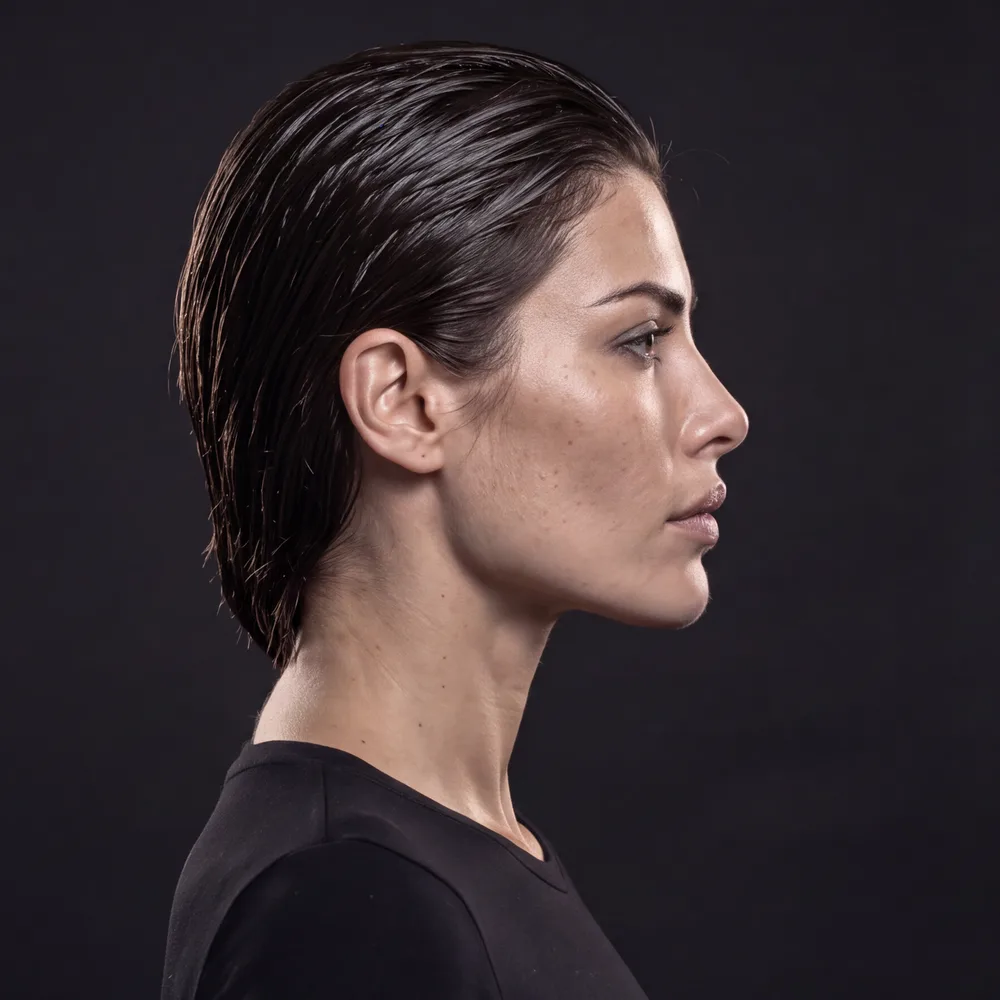
Take the same side-profile photo every four weeks, in the same place, light and time of day, with your head in the same position. It's the clearest way to see your routine working, because posture, puffiness and lighting shift by the hour.
- Set your phone at eye level on a shelf or tripod, an arm's length or two away, and use the timer.
- Stand side-on to it against a plain wall: ear over shoulder, eyes level, lips together, jaw relaxed.
- Take one shot in your normal posture and one in your best posture.
- Repeat in the same spot, light and time of day every four weeks.
- Compare the line from ear to chin and the angle under your chin, side by side.
Frequently asked questions
How long does it take to see results from jawline exercises?
Posture changes the look the moment you stack your head over your shoulders. Muscle and skin firm up over weeks: in facial resistance studies, skin was measurably firmer and an under-chin muscle larger after eight weeks. Fat loss shows over months. Take a side-profile photo every four weeks to see your progress.
Do jawline exercises work for men?
Yes. Men and women have the same muscles under the chin and along the neck, and the chin tuck against resistance worked those muscles in a study of 20 men and 20 women. The same levers apply too: body fat, head posture and the neck-to-chin angle. Skip extra chewing, which builds bite force, not a sharper jaw.
Is a jawline genetic?
Partly. Bone structure, including jaw length, the jaw angle and chin size, sets the frame. Everything around it is yours to change: body fat, head posture, the firmness of the muscles under your chin and the angle you are photographed from all shape how sharp your jaw looks.
Does mewing give you a sharper jawline?
Mewing isn't the shortcut. The American Association of Orthodontists says no current research shows it benefits the jawline or oral health, and warns that excessive pressure can disrupt how teeth line up. Train the muscles under your chin instead, and keep tongue exercises short, with the press on the palate rather than the teeth.
Does chewing gum make your jaw bigger?
No. In a six-month randomized trial, healthy adults who chewed gum three times a day gained bite force, but their masseter thickness and jaw shape did not change significantly. A sharper jaw comes from the muscles under your chin, your posture and your body fat. If your jaw clicks or aches, cut back on gum.
Can jawline exercises cause TMJ problems?
Moves that load the jaw joint, such as jaw jutting, hard gum and resistance gadgets, are the ones most likely to bother a sensitive jaw. Keep pressure light, and stop if you get pain, locking, clicking with pain or headaches. Symptoms that last deserve a dentist's assessment.
Sources
- Hwang UJ, Kwon OY, Jung SH, Ahn SH, Gwak GT. Effect of a facial muscle exercise device on facial rejuvenation. Aesthetic Surgery Journal, 2018. 50 women, 30 seconds twice a day for 8 weeks: larger zygomaticus major and digastric muscles, shorter jawline surface distances and a smaller lower-face volume.
- Kim K, Jeon S, Kim JK, Hwang JS. Effects of Kyunghee Facial Resistance Program (KFRP) on mechanical and elastic properties of skin. Journal of Dermatological Treatment, 2016. 16 women aged 35 to 58, 8 weeks: skin on the face and neck became firmer and more elastic.
- Seraj SS, et al. Efficacy of conservative techniques for mechanical facial rejuvenation: a systematic review. Aesthetic Surgery Journal Open Forum, 2025. 12 studies, 321 women: improvements reported in the cheeks, jawline and around the eyes; no adverse events reported.
- Yoon WL, Khoo JK, Rickard Liow SJ. Chin tuck against resistance (CTAR): new method for enhancing suprahyoid muscle activity using a Shaker-type exercise. Dysphagia, 2014. 40 healthy adults: more under-chin muscle activity than the lying head lift.
- Currier BS, et al. American College of Sports Medicine position stand: resistance training prescription for muscle function, hypertrophy, and physical performance in healthy adults. Medicine and Science in Sports and Exercise, 2026. 137 systematic reviews: progressive training builds strength and size, with strength gains from 2 to 3 sets and at least 2 sessions a week.
- Jung HJ, Hwangbo NK, Park Y, Ahn HJ. Effects of gum chewing training on occlusal force, masseter muscle thickness and mandibular shape: a randomised controlled clinical trial. Journal of Oral Rehabilitation, 2024. 58 healthy adults, 6 months: bite force rose; masseter thickness and jaw shape did not change significantly.
- Coetzee V, Chen J, Perrett DI, Stephen ID. Deciphering faces: quantifiable visual cues to weight. Perception, 2010. The cheek-to-jaw-width ratio was related to BMI, and observers used it to judge weight.
- Meira Pazelli A, et al. Hyoid position and aging: a comprehensive analysis using AI-assisted segmentation of 282 computed tomography scans. Plastic and Reconstructive Surgery Global Open, 2024. The hyoid sits lower with age and further forward with higher BMI. The 105 to 120 degree neck angle is cited from Ellenbogen and Karlin, 1980.
- Fedok FG, Chaikhoutdinov I, Garritano F. The difficult neck in facelifting. Facial Plastic Surgery, 2014. Excess fat, inelastic skin, a small chin and hyoid position blunt the neck angle.
- Fedorowicz Z, van Zuuren EJ, Schoones J. Botulinum toxin for masseter hypertrophy. Cochrane Database of Systematic Reviews, 2013. An enlarged masseter shows as a swelling at the jaw angle; injections are advocated for sculpting the lower face.
- American Association of Orthodontists. Does mewing actually reshape your jaw? No current research shows a benefit to the jawline or oral health; warns about pressure on the teeth.
- National Institute of Dental and Craniofacial Research. TMD (temporomandibular disorders). About 5% of US adults; self-care includes cutting back on clenching and gum chewing.
This article is educational and is not medical advice.