Face Exercises: What Actually Works (and a 10-Minute Routine)
Face exercises train the muscles under your cheeks, eyes, mouth and jaw. Here is what the studies found, which muscle each move works, and a 10-minute routine with a weekly plan and timeline.
On this page
Face exercises are deliberate, repeated movements that train the small muscles of your face and neck, such as the smile muscles across your cheeks. Done consistently, they build those muscles: in a Northwestern University study, 20 weeks of facial exercise gave women fuller upper and lower cheeks and cut their estimated age from 50.8 to 48.1 years.
Treat them like any training plan: a few moves, done with clean form, repeated for months and tracked with good photos. Whether you call it face yoga, facial exercises or a facial workout, the same rules apply.
Do face exercises actually work?
Yes, for the muscles they train. In the best-known study, women who practiced facial exercises for 20 weeks were rated as having fuller upper and lower cheeks, and their average estimated age fell from 50.8 to 48.1 years. Other studies have measured firmer, more elastic skin and a younger-looking upper lip after weeks of training.
That study ran at Northwestern University's Feinberg School of Medicine and was published in JAMA Dermatology. After two 90-minute lessons with an instructor, women aged 40 to 65 practiced resistance-based face exercises for 30 minutes a day for eight weeks, then every other day until week 20. Two blinded physicians rated their photos.
What the studies found
Here is what research on face exercises has found.
| Study | Who | Program | What they found |
|---|---|---|---|
| Alam 2018, JAMA Dermatology | Women aged 40–65 | 30 minutes daily for 8 weeks, then every other day to week 20 | Estimated age 50.8 → 48.1 years; fuller upper and lower cheeks |
| Kim 2016, Journal of Dermatological Treatment | 16 women aged 35–58 | A facial resistance program for 8 weeks | Skin on the face and neck became firmer and more elastic |
| De Vos 2013, Folia Phoniatrica et Logopaedica | 18 people, half of whom trained | 4 exercises daily for 7 weeks | The upper-lip area was judged younger-looking after training |
| Frazão 2024, CoDAS | 30 women aged 50–60 | Nine weekly 50-minute sessions of myofunctional therapy | Signs of facial aging eased; the gains faded after an 8-week break |
| Seraj 2025, systematic review | 12 studies, 321 women | 3 to 24 weeks of exercise, myofunctional therapy or massage | Improvements in the cheeks, jawline and around the eyes |
The same smile muscle grows with other kinds of training too: in a randomized trial of 108 women, 12 weeks of electrical muscle stimulation thickened the zygomaticus major by 18.6% (Kavanagh 2012).
What exercise changes, and what it doesn't
Exercise works on muscle. Bone, fat and skin follow their own rules:
- Bone. Exercise trains the muscle over your bones, not the bones themselves (British Orthodontic Society).
- Fat. Working one area doesn't burn the fat over it: six weeks of ab exercises didn't shrink belly fat in a randomized trial. Face fat follows body fat; see can face exercises slim your face?
- Skin. In an eight-week facial resistance program, skin on the face and neck became firmer and more elastic (Kim 2016). For long-term skin aging, add daily sunscreen: in a randomized trial of 903 adults, daily users showed 24% less skin aging than occasional users over four and a half years.
How do face exercises work?
Your face is built in layers: skin on top, then pads of fat, then a thin sheet of muscle, then bone. Face exercises train the muscle layer. As those muscles grow fuller and firmer, they support the fat and skin above them, so your cheeks look fuller and your midface more lifted.
Facial muscles aren't like gym muscles. Most expression muscles attach into skin or other soft tissue rather than running bone to bone, which is why contracting them moves your skin. There's no joint to load, so resistance comes from holding a position or from light fingertip pressure.
The training principles are the same as for any muscle: challenge it repeatedly, and a little more over time, and it grows, with more weekly work bringing more growth (ACSM position stand).
Which muscles do face exercises train?
Each move in the routine below targets one main muscle or muscle group. Here's what each muscle does and what you should feel. For the full anatomy, see this map of your facial muscles.
| Move | Main muscle | What the muscle does | What you should feel |
|---|---|---|---|
| Neck lengthener | Lower trapezius | Draws your shoulder blades down | Shoulders settling away from your ears |
| Cheek Lift | Zygomaticus major | Pulls the corners of your mouth up and out | Cheeks rising under your fingertips |
| Chin resistance | Suprahyoid muscles | Help you swallow, speak and open your jaw | Work under your chin |
| Lip press | Orbicularis oris | Closes and presses your lips | Even pressure along both lips |
| Eye opener | Levator palpebrae superioris | Lifts your upper eyelids | Lids lifting while your brows stay still |
| Jaw release | Masseter (massaged, not trained) | Closes your jaw when you chew | Jaw muscles letting go |
What is the most effective face exercise?
Start with the cheeks. Fuller upper and lower cheeks were the clearest result of the Northwestern study, and the main smile muscle, the zygomaticus major, thickened by 18.6% in 12 weeks when trained with electrical stimulation. The Cheek Lift trains that same muscle, which makes it the best first exercise.
The 10-minute face workout
This routine works your neck, cheeks, under-chin, lips and eyes, then releases your jaw. Do it seated, in front of a mirror or your phone's front camera, and rest 15 seconds between sets.
- Neck lengthener: 2 sets of 6, with 5-second holds (about 1.5 minutes)
- Cheek Lift: 3 sets of 5, with 3-second holds (about 2 minutes)
- Chin resistance: 2 sets of 8, with very light pressure (about 1.5 minutes)
- Lip press: 2 sets of 8, with 3-second holds (about 1.5 minutes)
- Eye opener: 2 sets of 6, with 3-second holds (about 1 minute)
- Jaw release: slow circles for 1 minute
With rests, the whole routine takes about 10 minutes.
Neck lengthener: set your posture
Neck lengthener
- Sit tall with your chin level.
- Lower your shoulders away from your ears, and hold.
- Keep your neck and jaw relaxed.
- Release the effort in your shoulders.
Start here because it sets your position for everything else: tall spine, level chin, shoulders down. Keep the range comfortable, and stop if you feel neck pain, numbness or dizziness. If your head tends to drift forward, try these forward head posture exercises.
Cheek Lift: the smile muscle
Cheek Lift
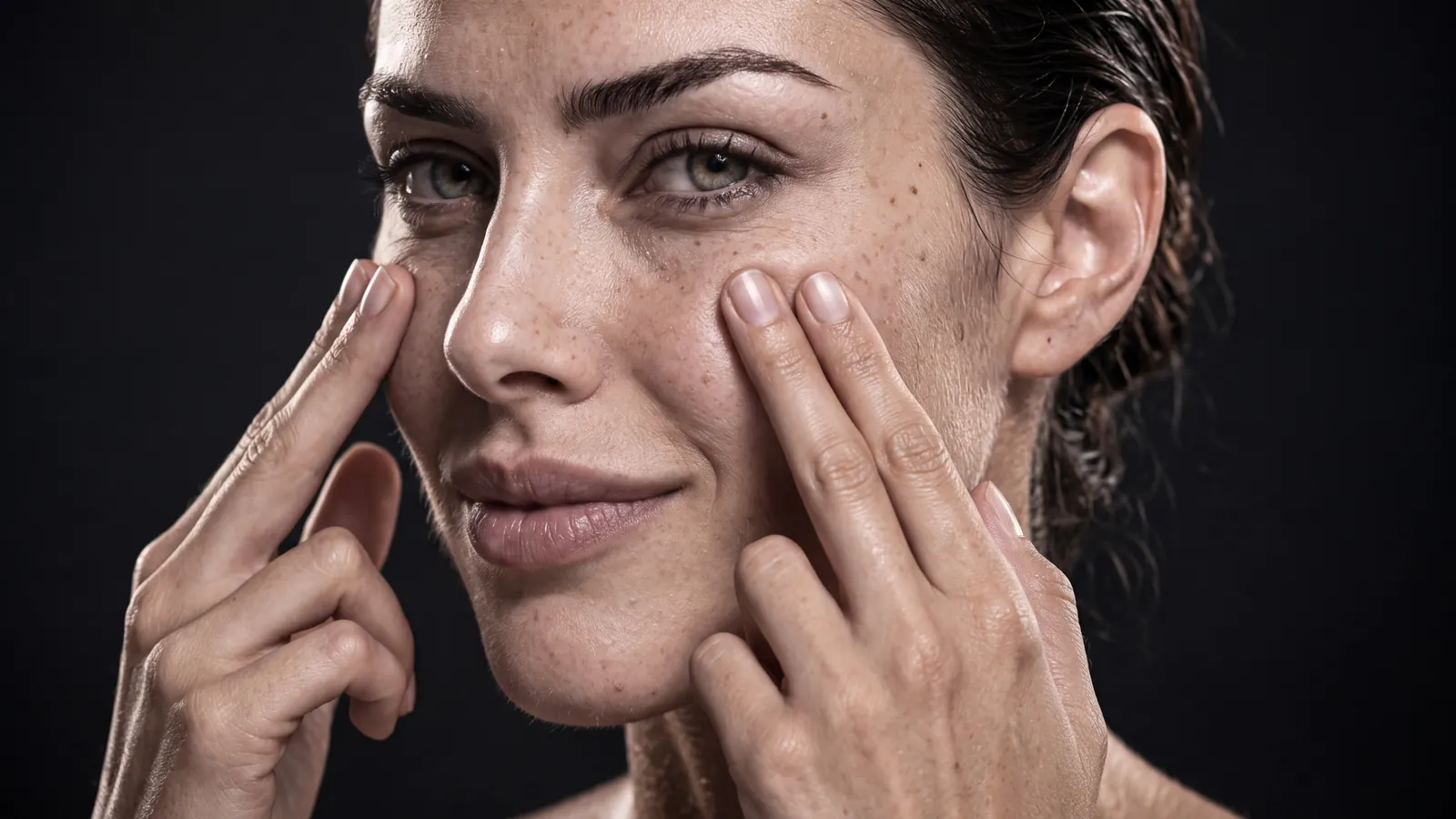
- Rest your fingertips lightly on both cheekbones.
- Smile wide, and feel your cheek muscles working.
- Hold, keeping your forehead relaxed.
- Release the smile.
Training the zygomaticus builds the muscle under your cheeks, so the midface looks fuller and lifted. The move is essentially a smile; the difference is that it's deliberate, held and repeated, with your fingertips telling you whether your cheeks rise. Keep your jaw loose and don't pull the skin. For more on cheek shape, see high cheekbones.
Chin resistance: under the chin
Chin resistance
- Rest a loose fist under your chin.
- Open your jaw slightly against your fist.
- Keep the resistance very light and your neck relaxed.
- Close your jaw slowly.
Swallowing therapists use a related move, tucking the chin against a small ball, because it strongly activates the muscles under the chin. Skip this one if you have jaw pain, locking or painful clicking. More in exercises for a double chin and jawline exercises that actually work.
Lip press: around the mouth
Lip press
- Close your lips softly, with your teeth apart.
- Press your lips together evenly along their whole length.
- Hold without pursing or clenching.
- Release.
Press, don't pucker. Pursing your lips again and again folds the same skin above them, and the American Academy of Dermatology warns that years of repeated expressions can leave permanent lines.
Eye opener: the upper eyelids
Eye opener
- Look straight ahead.
- Open your eyes wider without lifting your brows.
- Hold, keeping your forehead smooth.
- Relax your eyes.
Don't touch your eyes. If your brows creep up, make the movement smaller until they stay still. For what shapes the eye area, see hunter eyes: what you can and can't change.
Jaw release: cool down
Jaw release
- Rest your fingertips on both jaw muscles, between your cheekbones and the angles of your jaw.
- Trace small, gentle circles on both sides.
- Let your jaw hang loose and your shoulders drop.
- Lift your hands away.
This is the cool-down, not a strength move: you already work the masseter at every meal, so the aim is to let it relax. Stop if you feel jaw pain, worsening clicking or dizziness.
How often should you do face exercises?
Five or six days a week. The Northwestern program ran 30 minutes a day for eight weeks, then every other day until week 20. This routine follows the same pattern in 10 minutes: a build phase on most days, then every other day to maintain, with a few clean sets of each move.
Think of it as strength training for a small muscle group: a few clean sets on most days, progressed by adding a set or lengthening the holds once a move feels easy with perfect form. Never progress by pushing harder against your jaw.
Weeks 1–2
- Days per week
- 5
- Sets
- 1 per move
- Holds
- 3 seconds
- Focus
- Learn each move in a mirror; keep your forehead and jaw relaxed
Weeks 3–4
- Days per week
- 5–6
- Sets
- As written above
- Holds
- 3–5 seconds
- Focus
- The full 10-minute routine
Weeks 5–8
- Days per week
- 6
- Sets
- Add a set to the Cheek Lift and lip press
- Holds
- 5 seconds
- Focus
- Longer holds, only if your form stays clean
Week 9 onward
- Days per week
- 3–4, every other day
- Sets
- As in weeks 5–8
- Holds
- 5 seconds
- Focus
- Maintain, like the second phase of the Northwestern program
Keep going in some form. In a 2024 trial, the aesthetic gains from a therapist-led facial exercise program faded after an eight-week break (Frazão 2024).
How many times a day should you do face exercises?
Once a day is plenty. Extra rounds mostly add creasing, so if you want more work, add a set instead. Morning or night matters less than consistency, so tie the routine to something you already do, like brushing your teeth.
In a study of new daily habits, becoming automatic took anywhere from 18 to 254 days, and missing a single day didn't derail it (Lally 2010).
How long do face exercises take to work?
The moves feel easier within two or three weeks, and visible change builds from about two months. In the Northwestern study, average estimated age had fallen from 50.8 to 49.6 years by week 8 and to 48.1 by week 20, with fuller upper and lower cheeks. Track it with matched photos, since puffiness and posture shift from day to day.
- StartBaseline photos: same light, angle and time of day
- Weeks 1–3Moves get easier as your brain learns to recruit the muscles
- Weeks 3–4The muscles start to grow
- Week 8Northwestern study: estimated age 50.8 → 49.6
- Week 20Northwestern study: 48.1, upper and lower cheeks rated fuller
Keep going: in another trial, gains faded after an 8-week break.
Week by week:
- Weeks 1–3: the moves get easier as your nervous system learns them; early strength gains are mostly neural.
- Weeks 3–4: muscle growth becomes measurable.
- Week 8: in the Northwestern study, average estimated age had fallen from 50.8 to 49.6 years.
- Week 20: estimated age reached 48.1, with fuller upper and lower cheeks.
How to take progress photos that show the change
Light, camera angle, lens distance, expression and puffiness can change how a face looks from one photo to the next. Control them, and your progress shows clearly:
- Shoot at the same time of day, a couple of hours after waking.
- Use the same spot and the same light, ideally facing a window.
- Hold the phone at eye level and at arm's length.
- Pull your hair back and keep a neutral face: lips closed, jaw relaxed.
- Take three shots: front, left side and right side.
- Repeat every four weeks, and compare the photos side by side, never from memory.
Puffiness alone can change your face by the afternoon; see why your face gets puffy.
Face exercises vs face yoga, gua sha and Botox
Face exercises and face yoga are the same idea under different names: voluntary moves that work your facial muscles. Gua sha and facial rollers are massage, which raises blood flow for a short time. Botox works the opposite way: it temporarily relaxes chosen muscles to soften the lines they make.
Face exercises and face yoga
- What it does
- Train facial and neck muscles on purpose
- What studies found
- Fuller upper and lower cheeks and estimated age 50.8 → 48.1 years after 20 weeks; firmer, more elastic skin after 8 weeks
- Watch out for
- Jaw strain; repeated creasing
Gua sha and facial rollers
- What it does
- Massage skin and soft tissue
- What studies found
- A roller raised cheek blood flow for at least 10 minutes; facial contour distances fell 2.23–2.40 mm with gua sha and 2.75–3.26 mm with a roller after 8 weeks
- Watch out for
- Pressing too hard; broken or recently treated skin
Daily sunscreen
- What it does
- Protects skin from sun damage
- What studies found
- Randomized trial of 903 adults: 24% less skin aging with daily use than with occasional use
- Watch out for
- Skipping days
Botox (botulinum toxin)
- What it does
- Blocks the nerve signal so chosen muscles relax
- What studies found
- A medical treatment for lines caused by movement; effects usually last up to 3 to 4 months
- Watch out for
- It's a medical procedure: discuss the risks with a licensed clinician
They work on different layers, so they aren't either-or. If you've had Botox, fillers or facial surgery recently, ask the clinician who treated you before you start exercises or massage.
Are face exercises safe?
Yes, for most people, with gentle form. Avoid two things: forcing your jaw, which can strain its muscles and joint, and creasing the same skin over and over, since the American Academy of Dermatology says lines from repeated muscle contractions can become permanent. A few conditions call for a clinician's advice first.
Common mistakes:
- Pulling the skin. Fingertips rest; they never drag or stretch.
- Clenching. Keep your teeth apart and your jaw loose unless a move says otherwise.
- Recruiting your forehead. Watch for brow creases during the cheek and eye moves.
- Chasing a burn. These are small muscles; light, clean reps are the point.
Check with a clinician before you start if you have:
- Jaw joint (TMJ) problems, such as pain, locking or painful clicking. Temporomandibular disorders affect about 5% of US adults, and the National Institute of Dental and Craniofacial Research advises people with them to cut back on habits like jaw clenching and gum chewing.
- Recent fillers, Botox or facial surgery.
- Bell's palsy or another facial nerve problem. Tailored facial exercise therapy can help recovery, and it should be guided by a professional.
- Broken, inflamed or recently treated skin where your fingers would touch.
Face exercises by goal
Most people start with one feature in mind. Here's how training fits each goal.
- A sharper jawline: train the muscles under your chin and keep body fat in check, since jawline definition depends heavily on it. Read jawline exercises that actually work.
- A smaller double chin: chin work trains the muscles under your chin, while the fat there follows your overall body fat. Read exercises for a double chin.
- A slimmer face: working one area doesn't burn the fat over it, so face fat follows body fat. Read how to lose face fat.
- Less puffiness: puffiness often comes from fluid, short sleep or alcohol, not fat or muscle. Read why your face is puffy.
- Higher-looking cheekbones: the Cheek Lift trains the smile muscle that runs from your cheekbone to the corner of your mouth. Read how to get high cheekbones.
- Hunter eyes: eye shape comes from bone, fat, lid skin and brow position, and a relaxed brow is the part you control day to day. Read what hunter eyes are and what you can change.
- A more even face: every face has some asymmetry; learn what drives yours and what you can work on. Read what helps an asymmetrical face.
- A longer-looking neck: posture work brings your head back over your shoulders and your shoulders down. Read forward head posture exercises.
- Every muscle, explained: see the map of your facial muscles.
Frequently asked questions
Does face yoga really work?
Face yoga is the same idea as face exercises, and the best-known study supports it. At Northwestern University, women who practiced facial exercises for 20 weeks were rated as having fuller upper and lower cheeks, and their average estimated age fell from 50.8 to 48.1 years. Other studies have measured firmer, more elastic facial skin after eight weeks.
How long does it take for face exercises to work?
Plan on about two months for visible change. In the Northwestern study, average estimated age had fallen from 50.8 to 49.6 years by week 8 and to 48.1 by week 20, with fuller upper and lower cheeks. The moves themselves feel easier within the first two or three weeks as you learn to recruit each muscle.
Do face exercises work for men?
Yes. Men have the same facial muscles as women, and the same training principles apply: work a muscle consistently, with a little more challenge over time, and it adapts. The routine in this article suits anyone, and its neck and under-chin moves pair well with a jawline routine.
Can face exercises cause wrinkles?
Repeatedly creasing the same skin can deepen lines: the American Academy of Dermatology says lines from contracting the same muscles over many years can become permanent. Keep moves that fold your forehead or the skin around your eyes brief, relax the rest of your face as you train, and press your lips together rather than puckering.
Can face exercises change your bone structure?
No. Exercise trains the muscle layer that sits over your bones, and your bone structure stays the same. What changes is the muscle: training the zygomaticus major, for example, builds the muscle under your cheeks, so the midface looks fuller and lifted. That fullness is what raters scored in the Northwestern study.
Can face exercises lift a sagging face?
They lift and fill out the cheeks. In the Northwestern study, 20 weeks of facial exercise made upper and lower cheeks look fuller and cut estimated age from 50.8 to 48.1 years. Pair the routine with daily sunscreen, which cut skin aging by 24% compared with occasional use in a randomized trial of 903 adults.
Sources
- Alam M, et al. Association of facial exercise with the appearance of aging. JAMA Dermatology, 2018. Northwestern University study: 20 weeks of facial exercise; estimated age fell from 50.8 to 48.1 years and cheek fullness improved.
- Van Borsel J, et al. The effectiveness of facial exercises for facial rejuvenation: a systematic review. Aesthetic Surgery Journal, 2014. Systematic review of nine studies of facial exercise for facial rejuvenation.
- De Vos MC, et al. Facial exercises for facial rejuvenation: a control group study. Folia Phoniatrica et Logopaedica, 2013. Seven weeks of daily facial exercises; the upper-lip area was judged younger-looking.
- Seraj SS, et al. Efficacy of conservative techniques for mechanical facial rejuvenation: a systematic review. Aesthetic Surgery Journal Open Forum, 2025. 12 studies of 321 women; improvements in the cheeks, jawline and around the eyes.
- Kim K, et al. Effects of Kyunghee Facial Resistance Program (KFRP) on mechanical and elastic properties of skin. Journal of Dermatological Treatment, 2016. Eight weeks of facial resistance exercise; facial and neck skin became firmer and more elastic.
- Frazão YS, et al. Effectiveness of orofacial myofunctional intervention to mitigate facial aging signs: a clinical trial. CoDAS, 2024. Nine weekly sessions eased signs of facial aging; gains faded after an 8-week break.
- Kavanagh S, et al. Use of a neuromuscular electrical stimulation device for facial muscle toning: a randomized, controlled trial. Journal of Cosmetic Dermatology, 2012. Electrical stimulation thickened the zygomaticus major by 18.6% in 12 weeks.
- Hughes MC, et al. Sunscreen and prevention of skin aging: a randomized trial. Annals of Internal Medicine, 2013. 903 adults over 4.5 years; daily sunscreen users showed 24% less skin aging.
- Currier BS, et al. Resistance training prescription for muscle function, hypertrophy, and physical performance in healthy adults: an ACSM position stand. Medicine & Science in Sports & Exercise, 2026. How training volume, load and frequency build muscle.
- British Orthodontic Society. Claims about orthodontics, 2024.
- American Academy of Dermatology. 11 ways to reduce premature skin aging.
- National Institute of Dental and Craniofacial Research. TMD (temporomandibular disorders).
This article is educational and is not medical advice.