Facial Muscles: A Map of the Muscles That Shape Your Face
Anatomy references count anywhere from about 20 facial muscles to around 30 per side. Here is a labeled map of the main ones, what each does to your expressions and features, and which ones you can train.
On this page
Anatomy references count your facial muscles differently: about 20 in Cleveland Clinic's overview, and around 30 on each side in StatPearls, depending on how they're counted. Most are expression muscles that pull on your skin to smile, frown or raise a brow, while four pairs of chewing muscles move your jaw.
Facial muscles diagram
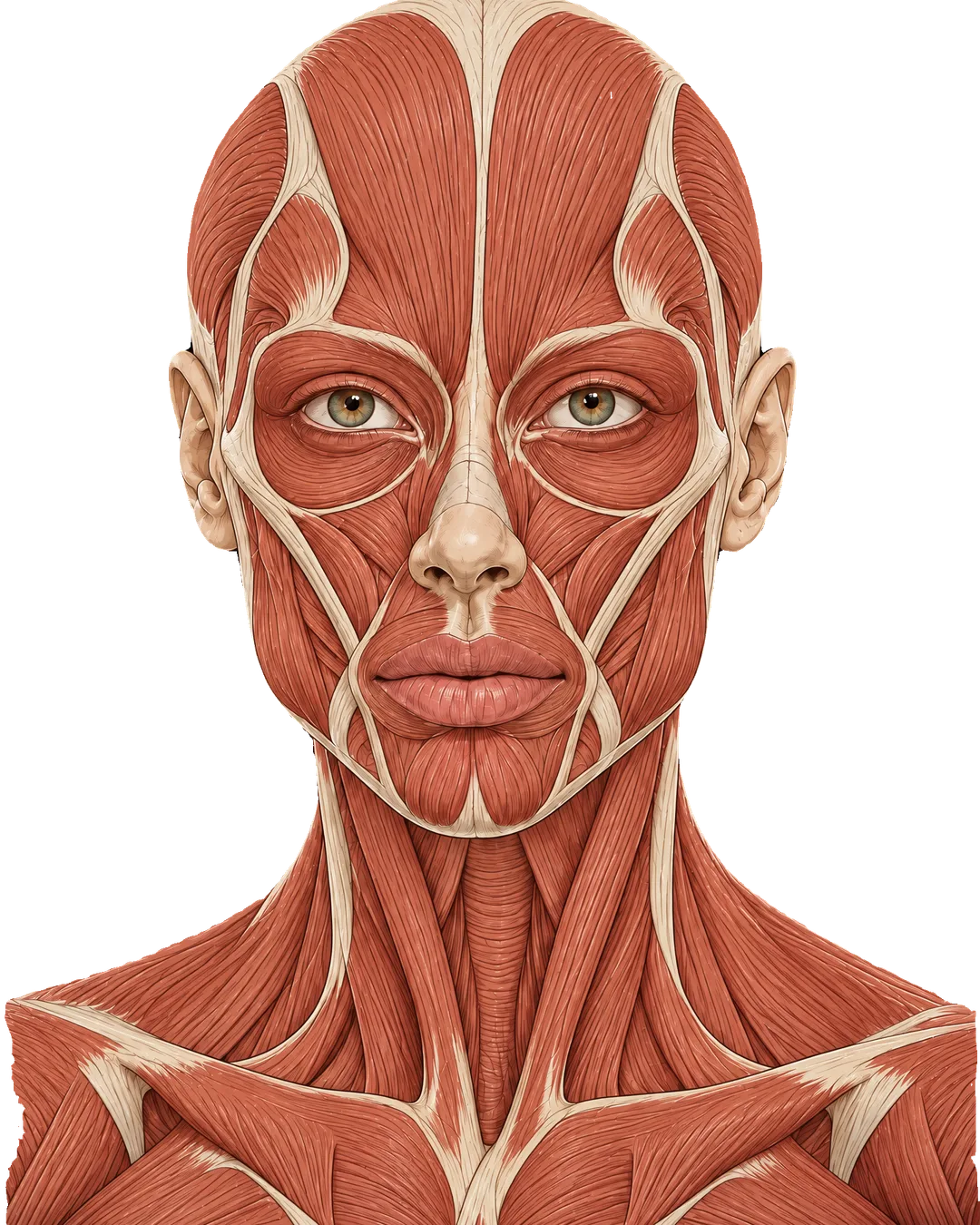
- FrontalisRaises the brows
- TemporalisCloses the jaw (chewing)
- Orbicularis oculiCloses and narrows the eyes
- Zygomaticus majorLifts the corners of the smile
- MasseterClenches and chews
- Orbicularis orisCloses and purses the lips
- MentalisRaises the chin and lower lip
- PlatysmaTenses the neck, pulls the mouth down
The map shows the muscles that matter most for how your face looks and moves. Read it from the top down: the forehead, the ring of muscle around each eye, the smile muscle crossing each cheek, the chewing muscles at the temple and jaw, the muscles around the mouth and chin, and the thin sheet over the neck.
Smaller muscles, such as the frown muscles between your brows and the lip lifters beside your nose, are covered in the tables below.
How many muscles are in your face?
There's no single official number. Cleveland Clinic counts about 20 flat skeletal muscles in the face; StatPearls, a medical reference, says around 30 on each side, depending on how they're counted. Faces also differ, and some people lack certain muscles entirely, so any exact figure, such as the often-repeated 43, depends on who's counting.
About 20facial muscles in Cleveland Clinic's overview
About 30per side in StatPearls, depending on how they're counted
4 pairsof chewing muscles move the jaw
34%of cheeks in one dissection study had a split zygomaticus major
Counts differ because references draw the lines differently: whether to include the chewing muscles, the small ear muscles that let some people wiggle their ears, or the separate parts of a muscle like the orbicularis oculi.
Bodies differ too. In a study of 18 cadavers, some facial muscles were missing or much larger on one side, though the muscles needed for universal expressions were present in everyone (Waller 2008). In 50 dissected cheeks, researchers found seven different muscle arrangements: a risorius or zygomaticus minor was relatively uncommon, and a third had a zygomaticus major split in two, the variant linked to cheek dimples (Pessa 1998).
That variation is also why the saying that frowning takes more muscles than smiling doesn't hold up. Nobody agrees on the count in the first place.
Expression muscles vs chewing muscles
Facial muscles fall into two working groups. Expression muscles, run by the facial nerve, pull on skin to make expressions and close your eyes and lips. Chewing muscles, run by a branch of the trigeminal nerve, move your jaw. The groups still work as a team: when you chew, your cheek and lip muscles keep food in place.
| Expression muscles | Chewing muscles | |
|---|---|---|
| Examples | Frontalis, orbicularis oculi, zygomaticus major, orbicularis oris, mentalis, platysma | Masseter, temporalis, medial and lateral pterygoids |
| Nerve | Facial nerve (cranial nerve VII) | Mandibular branch of the trigeminal nerve (V3) |
| Attachments | Mostly into skin and other soft tissue | Skull to jawbone |
| Main job | Expressions; closing the eyes and lips | Closing, opening and shifting the jaw |
| What you see | Expressions and the lines they leave | Bulk at the angle of the jaw (masseter) and the temple (temporalis) |
Sorting them by nerve mostly reflects how they develop in the embryo, which doesn't always match what they do (StatPearls). Two muscles in this article fit neither group: the levator palpebrae superioris, which lifts the upper eyelid and is run by the oculomotor nerve, and the suprahyoid muscles under the chin, which belong to the neck.
Facial muscles and their functions
Each facial muscle has a simple main job. The frontalis raises your brows, the orbicularis oculi closes your eyes, the zygomaticus major pulls your mouth corners into a smile, the orbicularis oris closes and purses your lips, and the masseter closes your jaw. The table maps each one to its visible effect and whether you can train it.
| Muscle | What it does | Visible effect | Can you train it? | Exercise |
|---|---|---|---|---|
| Frontalis | Raises the eyebrows; the only muscle that does | Brow height; horizontal forehead lines | Yes; keep the creasing brief | Brow raise against light fingertips |
| Corrugator and procerus | Pull the brows together and down | Frown lines between the brows and across the top of the nose | No need: they make frown lines | None; practice letting a frown go |
| Orbicularis oculi | Closes the eyelids; helps drain tears | Blinking and squinting; crow's feet | Yes: face yoga changed its tone and elasticity | Gentle squints, held briefly |
| Levator palpebrae superioris | Lifts the upper eyelid | How open your eyes look | Yes: opening your eyes wide works it | Opening your eyes wider, brows still |
| Zygomaticus major | Pulls the mouth corners up and out | Your smile; cheek fullness | Yes: it grows with training, and trained cheeks look fuller | Cheek Lift |
| Zygomaticus minor, levator labii superioris, levator anguli oris | Lift the upper lip and mouth corners | Upper teeth showing when you smile | Yes, in every full smile | Any full smile |
| Risorius | Draws the mouth corners sideways | A wide grin | Yes, if you have one: it works in a wide grin | None |
| Buccinator | Holds the cheek against the teeth; puffs the cheeks | The wall of the cheek | Yes: its tone rose after 8 weeks of face yoga | Cheek puffs |
| Orbicularis oris | Closes and purses the lips | Lip shape and closure | Yes: face yoga changed its tone and elasticity | Lip press |
| Depressor anguli oris | Pulls the mouth corners down | A downturned mouth | No need: it pulls a frown | None |
| Mentalis | Helps control the lower lip | Chin and lower-lip movement | Not a training target | None |
| Masseter | Closes the jaw with force | Width at the angle of the jaw | Already worked by chewing; gum didn't thicken it in a 6-month trial | Massage, not strengthening |
| Temporalis and pterygoids | Close, open and shift the jaw | Temple fullness (temporalis) | Not a training target | None |
| Platysma | Tenses neck skin; lowers the mouth corners; helps open the mouth | Tension and wrinkling in the neck skin | Not a training target | None |
| Suprahyoid muscles | Help you chew, swallow and speak | The area under the chin, along with fat and hyoid position | Yes: chin tucks against resistance work them hard | Chin resistance |
Forehead and brows: frontalis, corrugator, procerus
The frontalis is the only muscle that raises your eyebrows. Three muscles oppose it by pulling the brows down or together: the corrugator, the procerus and the orbicularis oculi. The balance between them sets where your brows sit and how they move (StatPearls).
All four insert into skin, so years of raising, frowning and squinting can leave lines: horizontal ones across the forehead, vertical ones between the brows from the corrugator (StatPearls), and a horizontal one across the top of the nose.
So train this area lightly: keep brow raises brief, and practice letting a frown go rather than strengthening it.
Around the eyes: orbicularis oculi and the eyelid lifter
The orbicularis oculi is a ring of muscle around each eye, with an outer part over the bony rim and an inner part within the lids. It closes your eyes, from a gentle blink to a hard squint, and helps drain tears (StatPearls).
Your upper lid is lifted by a different muscle, the levator palpebrae superioris. It isn't an expression muscle: it sits inside the eye socket, is run by the oculomotor nerve, and when it or its nerve fails, the lid droops (StatPearls).
In a CT study of 110 Japanese adults aged 20 to 87, the orbicularis oculi got thinner with age and loosened from the lower rim of the eye socket (Okuda 2023). It responds to training: in an eight-week study, electrical stimulation thickened the orbicularis oculi and improved under-eye fat bulging on the treated side (Okuda 2026). Eye shape also depends on bone, fat, lid skin and brow position; see hunter eyes: what the orbicularis oculi can and can't change.
Cheeks and smile: zygomaticus, lip lifters, buccinator
The zygomaticus major runs from the cheekbone to the corner of the mouth and pulls it up and out: it's the main smile muscle. Smaller muscles help. The zygomaticus minor, levator labii superioris and levator anguli oris lift the upper lip and mouth corners to show your upper teeth (StatPearls), and the risorius, in people who have one, draws the corners sideways (StatPearls).

- Zygomaticus majorPulls the mouth corners up and out: the main smile muscle
- Zygomaticus minorLifts the upper lip
- Levator labii superiorisRaises the upper lip beside the nose
- Levator anguli orisLifts the mouth corners
- RisoriusDraws the corners out to the side
- Depressor anguli orisPulls the corners down into a frown
The buccinator lies deeper and forms the wall of the cheek. It holds your cheek against your teeth when you chew and puffs your cheeks out when you blow, which is why it's nicknamed the trumpeter's muscle (StatPearls).
Training the zygomaticus builds the muscle under your cheeks, so the midface looks fuller and lifted. It's the facial muscle with the most training data, covered below. For how it combines with bone and fat in cheek shape, see the zygomaticus and the Cheek Lift.
Mouth and chin: orbicularis oris, depressors, mentalis
The orbicularis oris surrounds your mouth and closes and purses your lips. It isn't a simple ring: it's layered, has no bony or tendinous origin, and its fibers run in several directions, attaching into the skin of the lips (StatPearls). Many other mouth muscles attach to it.
Below the mouth, the depressor anguli oris pulls the corners down into a frown, the depressor labii inferioris helps move the lower lip, and the mentalis, at the center of the chin, helps control the lower lip (Cleveland Clinic).
If you work this area, press your lips together rather than puckering. Pursing again and again folds the same skin, and the American Academy of Dermatology warns that years of repeated expressions can leave permanent lines.
Jaw: masseter, temporalis, pterygoids
The masseter runs from the arch of your cheekbone to the angle of your jaw and closes your jaw with force; you can feel it bulge when you clench (StatPearls). The fan-shaped temporalis at your temple also closes the jaw, and the pterygoids, deeper inside, help close it, open it, push it forward and slide it side to side (StatPearls).
You already work these chewing muscles at every meal, and extra chewing doesn't enlarge them: in a six-month randomized trial, chewing gum three times a day raised bite force but didn't change masseter thickness or jaw shape (Jung 2024). Long, heavy chewing can also tire and strain the jaw. More on the masseter and jawline training.
Neck and under the chin: platysma, suprahyoids
The platysma is a thin sheet of muscle over the front of your neck. It wrinkles the neck skin, lowers the corners of your mouth and lower lip, and helps open your mouth: an expression muscle that happens to sit in the neck (Cleveland Clinic). Higher up, it merges with the SMAS, a fibrous sheet in the cheek.
Beneath it, four pairs of suprahyoid muscles (the digastric, stylohyoid, mylohyoid and geniohyoid) run between your jawbone and the hyoid bone in your throat. They help you chew, swallow and speak, and they steady the hyoid, which has no joint with any other bone (StatPearls).
Chin tucks against resistance work the suprahyoids hard; the move comes from swallowing therapy (Yoon 2014). The look of the area under your chin also depends on fat, skin and where your hyoid sits. See the platysma and suprahyoids in double chin training.
How are facial muscles different from body muscles?
Most facial muscles attach into skin or other soft tissue instead of running bone to bone across a joint. That's why contracting them moves your skin and shapes your expressions, and why folding the same skin for years can leave lines. They're also small and varied in fiber type, so you train them with holds and light resistance, not weights.
Three differences matter for training:
- They pull on skin. The forehead and eye muscles insert into skin, and the orbicularis oris has no bony origin at all. Many connect through the SMAS, a sheet of fibrous and muscle tissue in the cheek that joins the frontalis above and the platysma below (StatPearls).
- There's no lever to load. With no joint to move against, you can't add weight. Resistance comes from holding a position or from light fingertip pressure.
- Their fibers vary. In 14 expression muscles from nine bodies, fiber diameters ran from about 20 to 41 micrometers, and the share of slow-twitch fibers ranged from 14% in the muscles the authors classed as phasic to 67% in those they classed as tonic (Freilinger 1990).
And because expression muscles depend on the facial nerve, damage to it, as in Bell's palsy, weakens the muscles on that side.
Can you strengthen your facial muscles?
Yes. They're skeletal muscles under voluntary control, and they respond to training: the main smile muscle thickened by 18.6% after 12 weeks of electrical stimulation, eight weeks of face yoga changed the tone and elasticity of six facial muscles, and 20 weeks of facial exercise made cheeks look fuller.
The researchers measured each muscle directly with a handheld testing device and concluded that face yoga affects each muscle according to its structure and job. In plain terms, the forehead, brow, eye and mouth muscles relaxed, while the cheek wall and the muscle under the chin firmed up.
Other training studies point the same way:
- Exercise: in the Northwestern study, women who exercised for 20 weeks were rated as having fuller upper and lower cheeks, and their estimated age fell from 50.8 to 48.1 years (Alam 2018).
- A resistance device: holding a weighted mouthpiece in the lips for 30 seconds twice a day for eight weeks enlarged the zygomaticus major and digastric on ultrasound in 50 women, and reduced lower-face volume on 3D scans (Hwang 2018).
- Electrical stimulation: in a randomized trial of 108 women, 20 minutes a day, five days a week for 12 weeks thickened the zygomaticus major by 18.6% (Kavanagh 2012).
Across 12 studies of 321 women, a 2025 review found improvements in the cheeks, jawline and around the eyes (Seraj 2025). To train these muscles yourself, follow a consistent, progressive plan like the routine in our article on face exercises.
What happens to facial muscles as you age?
Aging changes every layer of the face: parts of the bone recede, fat pads shift and change volume, skin makes less collagen, and some muscles thin. Muscles also leave their own mark through expression lines, because repeated contraction folds the same skin. Wrinkle injections work by relaxing chosen muscles for a few months, not by strengthening them.
The bones of the midface and jaw recede in places, and some muscles thin: around the eyes, the orbicularis oculi gets thinner and loosens from the rim of the eye socket.
Lines are where muscles leave the clearest mark. The frontalis, corrugator, procerus and orbicularis oculi all insert into skin, and their pull, repeated for years, creases it (StatPearls).
That's how wrinkle injections work. Botulinum toxin, sold as Botox and other brands, blocks the chemical signal from nerve to muscle, so the injected muscle relaxes and the skin above it stops folding. Effects usually appear within a couple of days and last up to three to four months (StatPearls). In people who grind their teeth, jaw injections thinned the masseter at one and three months, but by six months treated and untreated patients measured alike (Taşdemir 2025).
It's the mirror image of face exercise: injections quiet muscles to soften lines, while exercise works them to add fullness. For the skin over all of these muscles, the best-proven protection is daily sunscreen, which cut skin aging by 24% compared with occasional use in a four-and-a-half-year randomized trial.
Frequently asked questions
What are the main muscles of the face?
The main ones are the frontalis, which raises your brows; the orbicularis oculi, which closes your eyes; the zygomaticus major, which pulls your mouth into a smile; the orbicularis oris, which closes and purses your lips; the mentalis in your chin; the platysma in your neck; and the masseter and temporalis, which close your jaw.
Which facial muscles do you use to smile?
A smile is led by the zygomaticus major, which pulls the corners of your mouth up and out. The zygomaticus minor, levator labii superioris and levator anguli oris lift your upper lip and mouth corners, and the risorius, if you have one, widens the grin. In one dissection study, a third of cheeks had a split zygomaticus major.
Does it take more muscles to frown than to smile?
Not in any fixed way. Anatomy references don't agree on how many facial muscles there are, and people differ: some lack a risorius or zygomaticus minor entirely. Both expressions use several muscles at once, so the count depends on how you define each muscle and each expression. The popular saying is folklore.
What nerve controls the facial muscles?
The facial nerve, cranial nerve VII, controls the muscles of expression. The chewing muscles, such as the masseter and temporalis, are controlled by the mandibular branch of the trigeminal nerve. The muscle that lifts your upper eyelid is different again: it's run by the oculomotor nerve, cranial nerve III, from inside the eye socket.
Which facial muscles cause wrinkles?
Lines tend to form where muscles fold the same skin for years. The frontalis creates horizontal forehead lines, the corrugator and procerus create frown lines between the brows, and the orbicularis oculi creates crow's feet. These are the muscles wrinkle-relaxing injections commonly target in the upper face. Sun damage and collagen loss in the skin matter too.
What is the muscle under your chin called?
Several muscles sit under the chin. Four pairs of suprahyoid muscles, the digastric, stylohyoid, mylohyoid and geniohyoid, run between your jawbone and the hyoid bone and help you chew, swallow and speak. The platysma, a thin sheet of muscle, covers the front of the neck, and the mentalis sits in the chin itself.
Sources
- Fakoya AO, et al. Anatomy, Head and Neck: Facial Muscles. StatPearls, 2024. Around 30 muscles per side, depending on how they are counted; which nerve runs each group.
- Cleveland Clinic. Facial muscles. Medically reviewed April 2025. About 20 facial muscles and what each does, in plain language.
- Pessino K, et al. Anatomy, Head and Neck: Frontalis Muscle. StatPearls, 2023. The only muscle that raises the brows; skin insertions explain expression lines.
- Waller BM, et al. Selection for universal facial emotion. Emotion, 2008. 18 cadavers: some facial muscles missing or asymmetric in some people.
- Pessa JE, et al. Variability of the midfacial muscles: analysis of 50 hemifacial cadaver dissections. Plastic and Reconstructive Surgery, 1998. Seven muscle patterns; a split zygomaticus major on 34% of sides.
- Freilinger G, et al. Histochemical mapping and fiber size analysis of mimic muscles. Plastic and Reconstructive Surgery, 1990. Fiber size and fiber type in 14 expression muscles.
- Güzel HÇ, et al. Effect of intensive face yoga on facial muscles tonus, stiffness, and elasticity in middle-aged women: a pre-experimental clinical trial. Medicina, 2025. Eight weeks of face yoga changed the tone, stiffness and elasticity of six facial muscles.
- Alam M, et al. Association of facial exercise with the appearance of aging. JAMA Dermatology, 2018. Northwestern University study: 20 weeks of facial exercise; fuller upper and lower cheeks, and estimated age fell from 50.8 to 48.1 years.
- Kavanagh S, et al. Use of a neuromuscular electrical stimulation device for facial muscle toning: a randomized, controlled trial. Journal of Cosmetic Dermatology, 2012. Electrical stimulation thickened the zygomaticus major by 18.6% in 12 weeks.
- Seraj SS, et al. Efficacy of conservative techniques for mechanical facial rejuvenation: a systematic review. Aesthetic Surgery Journal Open Forum, 2025. 12 studies of 321 women; improvements in the cheeks, jawline and around the eyes.
- Okuda I, et al. Basic consideration for facial aging: age-related changes of the bony orbit and orbicularis oculi muscle in East Asians. Aesthetic Surgery Journal, 2023. CT of 110 adults aged 20 to 87: the orbicularis oculi thins with age.
- Biello A, Zhu B. Botulinum Toxin Treatment of the Upper Face. StatPearls, 2023. Cited for how the treatment works, not for dosing or technique.
This article is educational and is not medical advice.