Hunter Eyes: What They Are, How to Tell, and What You Can Change
Hunter eyes come mostly from bone and eyelid anatomy. Here is how to read your own eye area, what attractiveness research found, and the changes that sharpen the look without surgery.
On this page
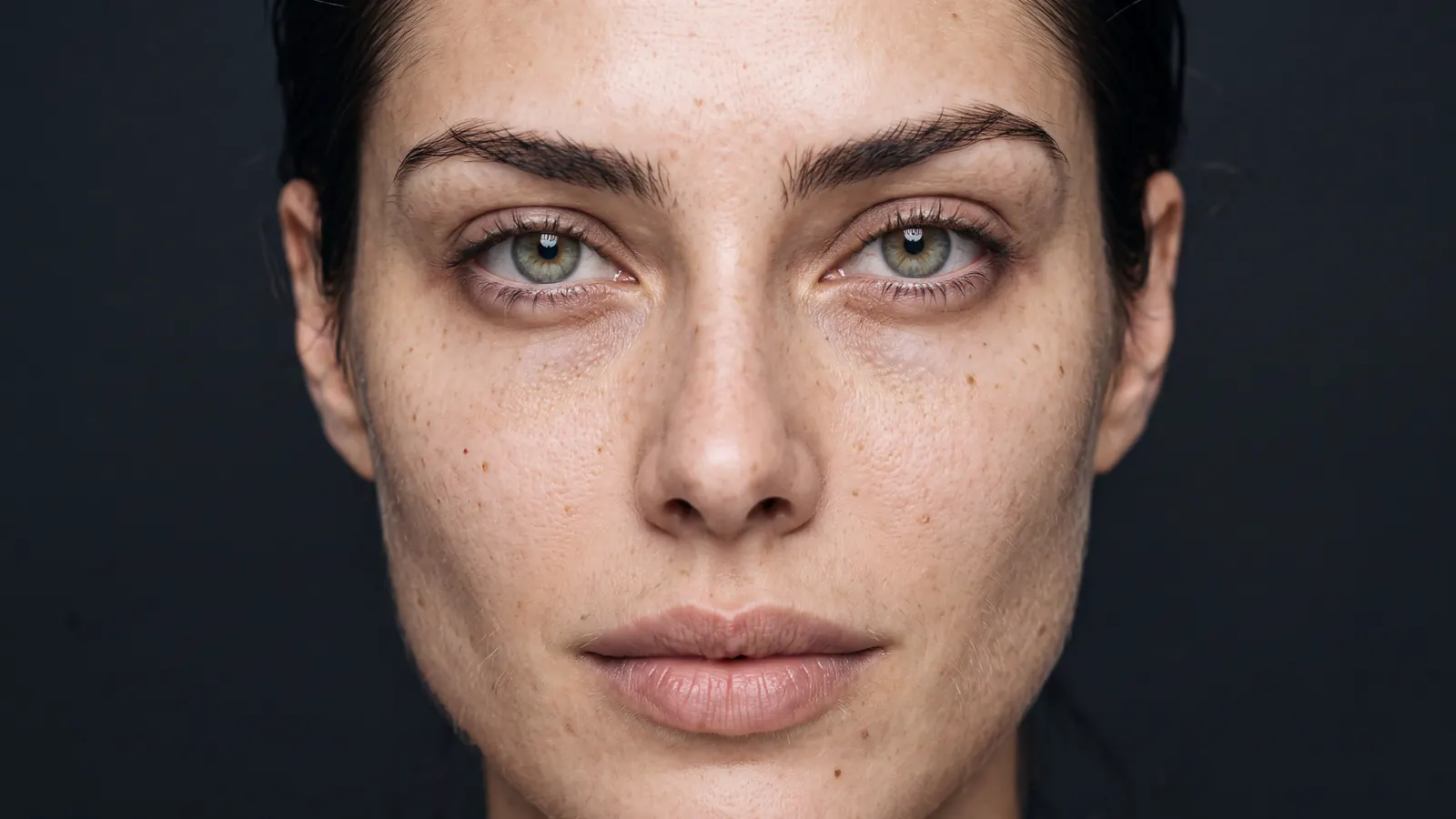
Hunter eyes are deep-set eyes under a low, fairly straight brow, with little visible upper eyelid and an outer corner that sits level with or above the inner corner. The look starts with bone and eyelid anatomy, and you can push your eyes toward it by controlling your brow, your lids and how you're photographed.
The term comes from looksmaxxing forums, where its opposite is "prey eyes". Neither is a medical category; both describe features that vary on a spectrum, and most people have a mix.
Here's what creates the look, how it reads to other people, and exactly what you can do with yours.
What are hunter eyes?
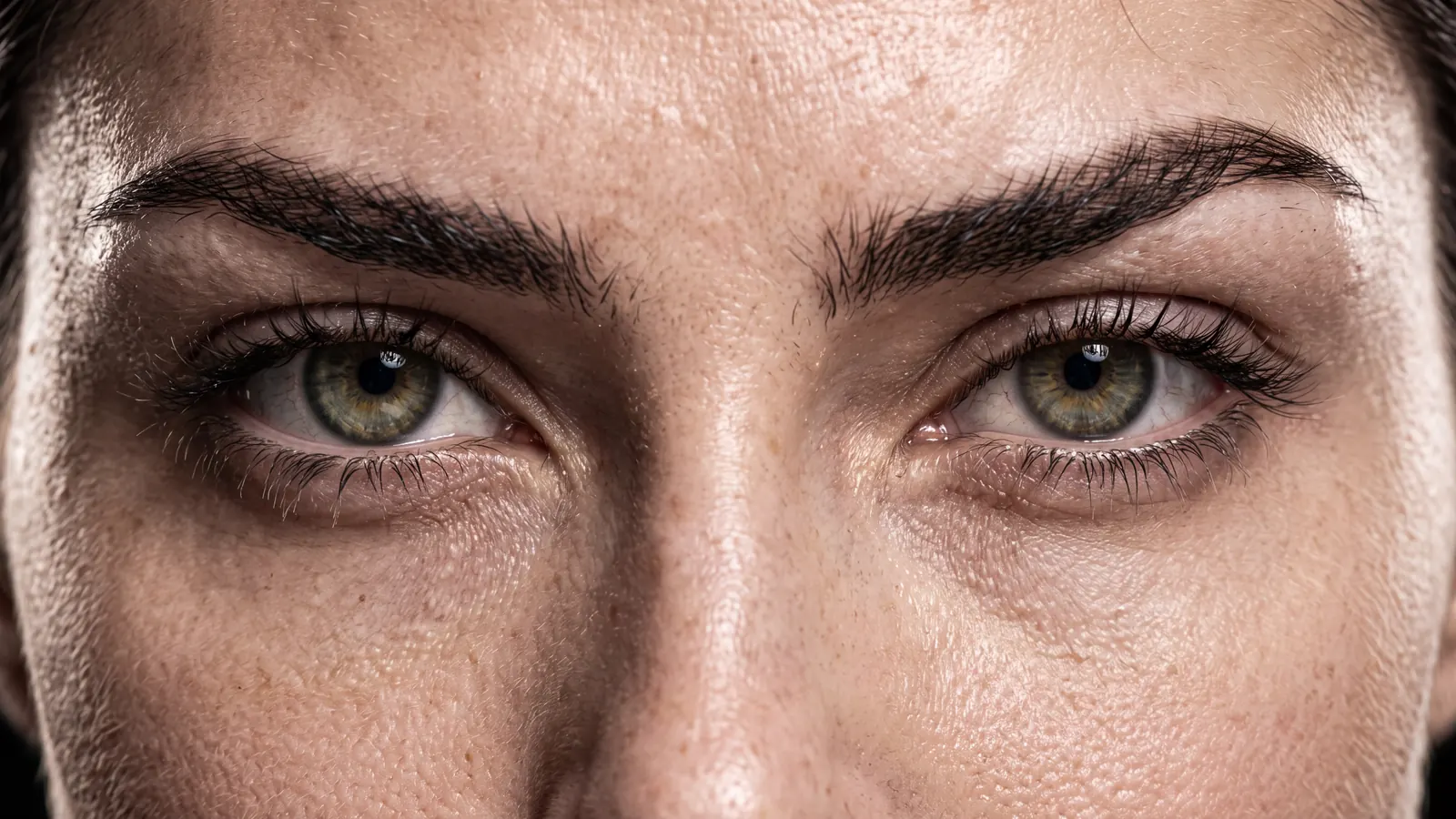
Hunter eyes are a combination of six features: a projecting brow ridge, a low and flat brow, little visible upper lid, a neutral or positive canthal tilt, a straight lower lid, and little white showing around the iris. Together they make the eyes look narrow, deep-set and intent.
- Brow ridge. The bony shelf above each eye socket. A more projecting ridge shades the eye and makes it look deeper set. Brow ridges tend to be more prominent in men.
- Brow position and shape. Low and fairly flat. In a study of 222 men, the brow sat along the bony ridge with a flat contour, and men with deeper-set eyes had lower brows (Goldstein and Katowitz, 2005).
- Upper-lid show. The strip of eyelid visible between your lashes and the fold below your brow. Hunter eyes show little or none, because the eye sits deep or the lid is hooded.
- Canthal tilt. The angle of a line from your inner eye corner to your outer corner: level, or slightly up at the outer corner.
- Lower lid. Fairly straight, resting against the bottom edge of the iris rather than curving down.
- Scleral show. How much white shows above or below the iris. Hunter eyes show little.
Two of these are under your direct control. The frontalis, across your forehead, is the only muscle that raises your brows, and the orbicularis oculi muscle, the ring around each eye, lifts the lower lid when you squint. Bone, the tendon that anchors your outer eye corner, and eyelid skin and fat set the rest.
Hunter eyes
Prey eyes
- Brow ridgeHeavier shading under the brow on the hunter side
- Brow height and shapeLow and flat, or high and arched
- Upper-lid showHow much eyelid shows between lashes and crease
- Canthal tiltThe line from the inner to the outer corner, against level
- Lower lidStraight and touching the iris, or curved below it
- Scleral showWhite visible below the iris
Hunter eyes vs prey eyes
Prey eyes is forum slang for the opposite cluster: rounder eyes under higher, arched brows, a visible upper lid, a level or downward outer corner, and white showing below the iris. It isn't a flaw or a diagnosis. Both labels describe normal variation, and many faces people find beautiful have rounder, open eyes.
Hunter or prey? Check your eyes
Tap the side that sounds like you.
Brow
Mostly set by: Bone, brow fat, forehead habits
Upper lid
Mostly set by: Eye depth, lid skin and fat
Canthal tilt
Mostly set by: Bone, the outer-corner tendon, age
Lower lid
Mostly set by: Lid support, age
White of the eye
Mostly set by: Lid position, eye prominence
Overall shape
Mostly set by: All of the above
Do I have hunter eyes?
Check six things in a neutral, evenly lit photo: brow height, brow shape, upper-lid show, canthal tilt, lower-lid shape and white below the iris. If most land in the hunter column, you have the look. Most people land somewhere in between, and expression, light and camera angle can all shift the result.
Take the photo like this:
- Face a window so daylight falls evenly on both eyes. Overhead light shadows the sockets and fakes depth.
- Hold the camera at eye level, at least an arm's length away. Close-up selfies distort proportions.
- Relax your forehead, keep your chin level and look into the lens. Take three shots and keep the most neutral.
- Zoom in. Where does your brow sit against the bony ridge? How much upper lid shows? Is there white below the iris?
- For canthal tilt, draw a line from the inner to the outer corner of each eye and compare it with a horizontal line: up is positive, level is neutral, down is negative. Keep your head level, or the angle means nothing.
Check both sides. Small differences are normal; if one eye or lid looks clearly different, see our article on uneven eyes and facial asymmetry.
Are hunter eyes attractive? What research says
Yes, in the right measure. Faces rated attractive tend to have lower brows, and in many groups a slight upward tilt at the outer corner. Push the outer corner too high, though, and a face reads as dominant rather than attractive: that's how 2,081 raters saw an edited face with raised outer corners.
| Study | What researchers did | What they found |
|---|---|---|
| Bashour and Geist, 2007 | Showed judges female faces next to copies with canthal tilt accentuated in Photoshop | Edited faces chosen 93% of the time |
| Rhee et al., 2012 | Measured attractive and average composite faces from several ethnic groups | Lower brows and wide-set eyes in every group; steeper slant in Caucasian and African composites, less steep in Asian ones |
| Sforza et al., 2015 | 3D-scanned 126 Italian beauty-competition entrants and 199 peers aged 18 to 30 | Longer eye openings in attractive women and men, and more tilted ones in the attractive group |
| Kempa et al., 2025 | Raised the brows and outer corners of an edited unisex face in steps; 2,081 raters | Higher brows and higher outer corners read as more dominant and threatening, and less attractive |
Read together: a lower brow scores well and a slight upward tilt helps, while an outer corner pushed higher reads as threatening. Aim for a low, calm brow and a hint of lift.
Is it rare to have hunter eyes?
Hunter eyes is a spectrum rather than a yes-or-no trait: each feature varies, and most people have some of each. The full set, a heavy brow ridge over deep-set eyes, is more common in men, whose brow ridges tend to be larger.
Are hunter eyes genetic?
Mostly. Brow-ridge projection, eye-socket depth and where your eye corners sit are built into your skull and eyelid anatomy. In 3D scans of 952 twins, the shape around the inner eye corners and the curves around the eye sockets were among the most strongly inherited parts of the face. Age changes the rest.
That twin study measured how much of the variation between people traces back to genes (Tsagkrasoulis et al., 2017). Heritable doesn't mean fixed, though, and the eye area changes with age, mostly away from the hunter look. When researchers compared photos of the same 80 people at 20, 40 and 60, the outer eye corner sat lower in 40% of them by 60, and excess upper-lid skin was present in 67.5% (De Biasio et al., 2019).
What isn't inherited: puffiness from short sleep, a habit of holding your brows up, and how you light and frame a photo. Those are the parts within reach.
Can you get hunter eyes naturally?
You can get closer than you might think by working on what's in your control. Bone sets the brow ridge, eye depth and canthal tilt, but the brow's resting position, lid puffiness and the lower lid are yours to change: drop a brow-raising habit, sleep enough, ease puffiness and master the lower-lid squinch photographers use.
For a full routine for the rest of your face, see our article on face exercises.
What you can change, and what you can't
| Part of the look | Changeable without surgery? | What helps |
|---|---|---|
| Brow ridge, eye depth, canthal tilt | No | Set by bone and tendon; tilt can drift down with age |
| Brow height at rest | A little | Dropping a brow-raising habit; grooming |
| Upper-lid show | A little | A resting brow; eyeliner that defines without adding lid |
| Puffiness | Partly | Enough sleep; a cool compress in the morning |
| Fullness from body fat | Partly | Overall fat loss shows more of the bone around the eyes |
| Lower-lid position | On cue | The squinch |
| How your eyes photograph | Yes | Even light, camera at eye level, level chin |
Four eye-area control drills
These drills train control of the two muscles that shape how your eyes read. Use a mirror or your front camera, keep them gentle, and stop if anything stings or aches.
Brow reset
- Glance at your reflection in the middle of something ordinary: reading, typing or talking.
- Notice whether your brows are lifted and your forehead creased.
- Breathe out and let your forehead go slack until your brows settle on their own. Don't pull them down with a frown.
- Hold the quiet brow for three slow breaths, eyes soft.
Many people hold their brows up without noticing. Let them rest and they settle at their natural position, lower and closer to the eye, with fewer forehead creases as a bonus: the American Academy of Dermatology warns that contracting the same muscles for years can make lines permanent (AAD).
Lower-lid squinch
- Look at a point across the room with a relaxed face.
- Lift your lower lids slightly, as if the light just got a little brighter. Keep your upper lids and outer corners still.
- Hold for three seconds, then release fully.
- Check the mirror: you want focused, not squinting.
The squinch is the fastest hunter-eye effect there is: it narrows the eye and focuses your gaze instantly, which is why photographers coach it. Practice until it comes on cue, then stop: in people seeking surgery for eye bags, an overactive eye-ring muscle was one of six contributors to the bulge (Goldberg et al., 2005).
Brow balance check
- Prop your phone at eye level with the front camera on.
- Read a paragraph aloud and watch whether one brow lifts more often, or higher, than the other.
- Read it again with both brows quiet and level, then finish with a brow reset.
Under-eye depuff sweep
- Wash your hands and use your ring fingers, the lightest touch you have.
- Start at the inner corner, on the bone below your eye, never on the eye itself.
- Glide slowly outward along the bone to the outer corner, then on toward your temple.
- Lift off, return to the start and repeat.
Do it in the morning with cool fingertips, or swap in a cool compress. Skip it with irritated skin, an eye infection, or recent eyelid surgery, fillers or Botox nearby.
Bags that last all day usually aren't just fluid: in that surgical study, cheek descent, bulging fat and loose skin contributed too, and no single cause dominated. Our article on puffy eyes and face covers what helps.
Sleep matters more than any sweep. After 31 hours awake, 10 people were rated by 40 observers as having more hanging eyelids, more swollen eyes and darker circles than after a normal night (Sundelin et al., 2013).
Light, angle and posture
Light and angle change the read. Overhead light deepens the shadow under the brow, and a phone held close exaggerates whatever is nearest the lens. Compare photos in the same window light, with the camera at eye level and your chin level. Head position matters too; see our article on forward head posture.
Hunter eyes for women
Women can have every hunter-eye feature; the same cluster is often called almond, fox or siren eyes. The difference is usually styling: a softer brow and an outer corner lifted with makeup. In a large 2025 study, women saw raised outer corners and brows as less feminine, so subtle tends to work better.
Taste varies by culture, too. Attractive Caucasian and African composite faces had a steeper eye slant than average ones, and attractive Asian composites a less steep one (Rhee et al., 2012). In East Asia, a popular cosmetic eye surgery lowers the outer corner, because an upward slant can make the eyes seem smaller, with a strong appearance (Kim et al., 2016).
Without surgery, grooming and makeup do most of the work:
- Brows. Keep the front full and fairly straight, and don't over-pluck the lower edge, which raises the brow. Let the tail lift slightly.
- Liner. Tightline the upper waterline to define the eye without adding lid, and extend a fine wing along the angle of the lower lash line.
- Shadow and lashes. On hooded lids, place a matte shade just above the crease so it shows with your eyes open. Deepen the outer third and concentrate lash volume there.
Fox-eye and cat-eye lifts are medical procedures with real risks; see the surgery section below.
Canthal tilt: what sets it and how to work with yours
Canthal tilt is the angle of the line from your inner eye corner to your outer corner. Positive means the outer corner sits higher; negative means lower. Bone and the tendon that anchors the outer corner set it, and it can drift downward with age, so you work with your tilt through the lower lid and makeup.
The famous 93% comes from a 2007 study in which judges preferred female faces with Photoshop-accentuated canthal tilt over the originals (Bashour and Geist, 2007). Tilt is a powerful attractiveness cue, which is why a liner wing that lifts the outer corner is such a reliable trick.
Age tends to move tilt the wrong way for the hunter look: in Western practice, canthoplasty is typically used to lift an outer corner that has slanted down, usually with age (Kim et al., 2016).
Your outer corner is anchored to bone by a tendon, so the squinch changes how the eye reads while you hold it, and liner and lashes carry the lift the rest of the time.
Trends to skip, and what surgery involves
Skip bone smashing, hours of squinting and any routine promising a new canthal tilt in days. Bone smashing can injure you, squint holds etch lines, and tilt is anchored by bone and tendon. Changing eye shape itself means surgery, such as eyelid surgery or canthoplasty, with recovery time and real risks, so get an oculoplastic or facial plastic surgeon's opinion.
- Bone smashing. Hitting the brow and cheekbones to remodel them is a dangerous trend. A 2026 analysis found searches for it up 5,000% in a year, with popular posts leaning on pseudoscientific language and downplaying risk (Grillo et al., 2026).
- Squint holds. Narrowing your eyes for minutes a day trains an expression, not a shape. The AAD recommends sunglasses to reduce squint lines; deliberate squinting works against that.
If you're considering surgery, know what each option does:
- Upper eyelid surgery (blepharoplasty) removes excess lid skin, which becomes common with age.
- Canthoplasty re-anchors the outer corner to change its height or the eye's length. A surgical review lists common complications: a misshapen outer corner, the change slipping back, exposure of the pink inner lining of the lid, and a lower lid that turns outward, which can dry the eye (Kim et al., 2016).
- Brow lifts raise the brow, which usually moves you away from the hunter look, not toward it.
Frequently asked questions
What is the difference between hunter eyes and prey eyes?
Hunter eyes are deep-set, with a low, flat brow, little visible upper lid and an outer corner level with or above the inner one. Prey eyes is slang for the opposite: rounder eyes, higher brows, a visible lid and a level or downward outer corner. Both are normal variations, not medical categories.
Can you get hunter eyes with exercises?
Exercises and habits work on the parts of the look you control: a relaxed brow that rests lower, less puffiness, and a lower lid you can lift on cue with the squinch. Canthal tilt, brow-ridge bone and eye depth come from your skull, so put your effort into the brow, the lids and how you are photographed.
Are hunter eyes genetic?
Mostly. Bone structure, eye depth and where the eye corners sit are inherited, and a 3D scan study of 952 twins found the area around the inner eye corners among the most heritable parts of the face. Age matters too: in one photo study, the outer eye corner sat lower by 60 in 40% of people.
Can women have hunter eyes?
Yes. Women can have every hunter-eye feature, and the look is often called almond or fox eyes. Brow grooming and eyeliner can lift the outer corner visually. In a study of 2,081 raters, women saw raised brows and outer corners as less feminine, so a subtle version is the safer choice.
Can you change your canthal tilt naturally?
Canthal tilt is set by bone and the tendon that anchors your outer eye corner, so changing it means surgery, which carries risks such as a misshapen corner, relapse or dry eye. Without surgery, you change how tilted your eyes look: a lower lid lifted with the squinch, and a liner wing that follows the lower lash line.
Is it rare to have hunter eyes?
Hunter eyes is a spectrum rather than a yes-or-no trait: each feature varies, and most people have a mix of hunter and prey features. The full set, a heavy brow ridge over deep-set eyes with a level or upward outer corner, is more common in men, whose brow ridges tend to be larger.
Sources
- Bashour M, Geist C. Is medial canthal tilt a powerful cue for facial attractiveness? Ophthalmic Plastic and Reconstructive Surgery, 2007. Photoshop-edited female faces; forced-choice judgments.
- Kempa J, et al. Understanding the impact of eyebrow and lateral canthal height on the perception of character traits. Journal of Plastic, Reconstructive and Aesthetic Surgery, 2025. 2,081 raters, average age 26; one edited unisex face in nine versions.
- Rhee SC, et al. Biometric study of eyelid shape and dimensions of different races with references to beauty. Aesthetic Plastic Surgery, 2012. Measurements of attractive and average composite faces from several ethnic groups.
- Sforza C, et al. Comparison of soft-tissue orbital morphometry in attractive and normal Italian subjects. The Angle Orthodontist, 2015. 3D facial landmarks of 126 beauty-competition participants and 199 peers aged 18 to 30.
- Goldstein SM, Katowitz JA. The male eyebrow: a topographic anatomic analysis. Ophthalmic Plastic and Reconstructive Surgery, 2005. Brow measurements in 222 men aged 10 to 86.
- Tsagkrasoulis D, et al. Heritability maps of human face morphology through large-scale automated three-dimensional phenotyping. Scientific Reports, 2017. 3D facial scans of 952 twins from the TwinsUK registry.
- De Biasio F, et al. Study on the aging dynamics of the periorbital region. Ophthalmic Plastic and Reconstructive Surgery, 2019. Photos of the same 80 people at ages 20, 40 and 60.
- Kim YJ, et al. Cosmetic lateral canthoplasty: preserving the lateral canthal angle. Archives of Plastic Surgery, 2016. Surgical review of technique and common complications.
- Sundelin T, et al. Cues of fatigue: effects of sleep deprivation on facial appearance. Sleep, 2013. 10 people photographed rested and after 31 hours awake; 40 raters.
- Goldberg RA, et al. What causes eyelid bags? Analysis of 114 consecutive patients. Plastic and Reconstructive Surgery, 2005. People seeking eyelid surgery; six contributing causes, none dominant.
- Grillo R, et al. Dangerous trends on social media related to facial esthetics: analysis of looksmaxxing and its softmaxxing and hardmaxxing practices. Journal of Stomatology, Oral and Maxillofacial Surgery, 2026. Social-listening study of bone smashing and related trends.
- American Academy of Dermatology. 11 ways to reduce premature skin aging. Advises avoiding repetitive facial expressions and squinting.
This article is educational and is not medical advice.