Asymmetrical Face: Why One Side Looks Different and What You Can Fix
No face is perfectly symmetrical. Learn to tell camera tricks from real asymmetry, sort yours into bone, muscle or habit, and see what each type responds to.

On this page
- Is an asymmetrical face normal?
- Why does my face look asymmetrical in photos?
- What causes facial asymmetry?
- The 2-minute asymmetry self-check
- Can you fix an asymmetrical face naturally?
- Exercises for a more even face
- Can sleeping or chewing on one side cause asymmetry?
- Treatments for structural asymmetry
- When is facial asymmetry an emergency?
An asymmetrical face is normal. Every face measured in 3D studies shows some difference between its left and right halves, usually less than a millimeter on average. What matters is which kind you have: camera distortion and habits are quick fixes, muscle control is trainable, and bone or bite differences are a job for an orthodontist.
This article helps you sort yours. You'll see why photos make it look worse, run a two-minute self-check, learn the habits to change and the drills to train, and know when a lopsided face is a medical emergency.
Is an asymmetrical face normal?
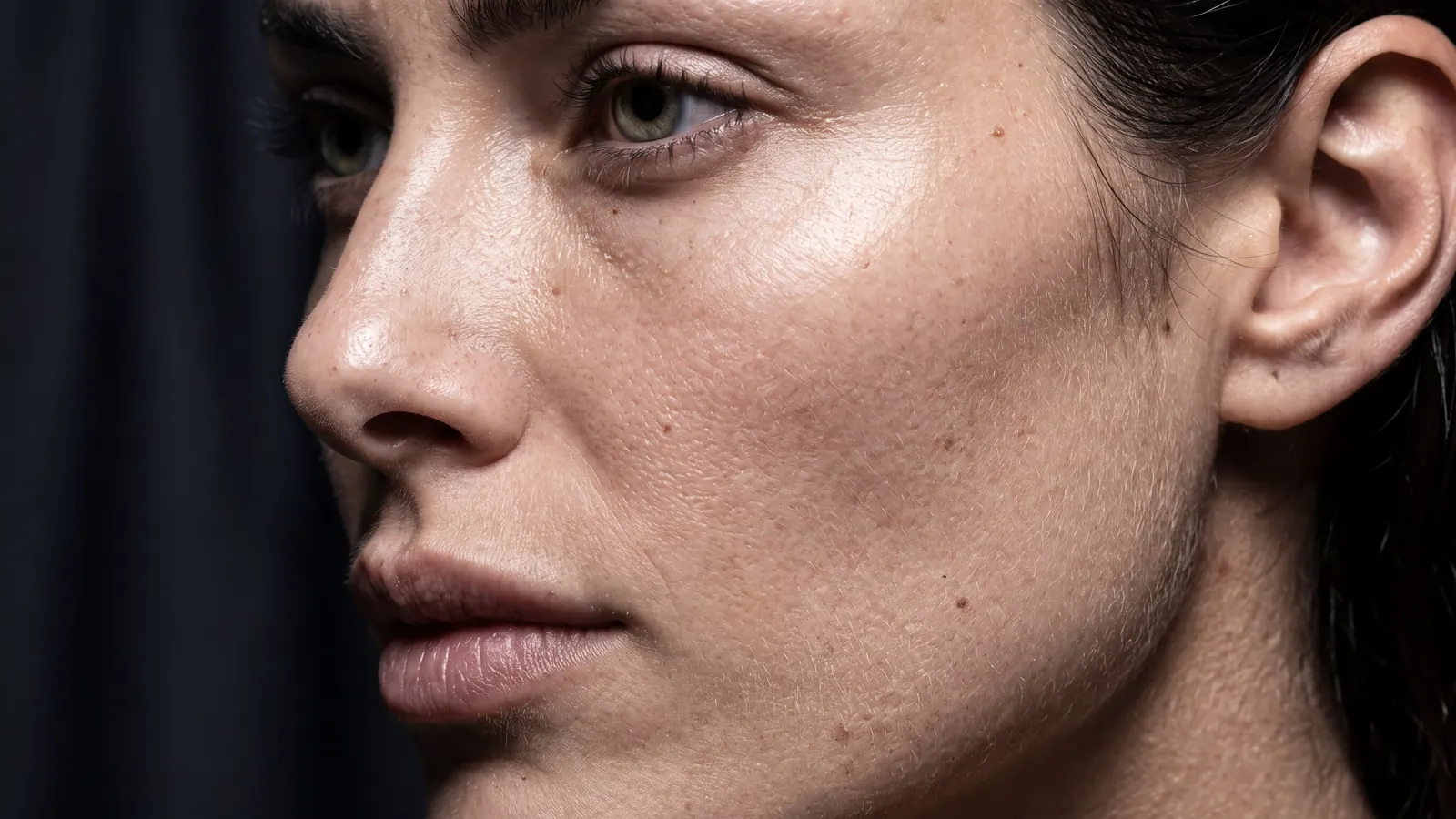
Yes. Perfect symmetry is rarely found in real faces. In 3D scans of 191 people, from infants to 88-year-olds, the two halves differed by about 0.8 mm on average, and a study of 80 healthy young adults found some soft-tissue asymmetry in every face. Most of it is too small for anyone, including you, to notice.
The differences follow patterns. Among 1,800 orthodontic patients, 79.7% of those with measurable asymmetry had a wider right half, and most chin deviations leaned left. The pattern held regardless of sex, age or jaw type, the mark of an inherited trait.
Muscles differ too. Some facial muscles often show marked asymmetry, larger on one side or missing on one side, while the muscles behind basic expressions are present in everyone. So asymmetry isn't only bone deep.
How big does a difference have to be before people see it? A 2015 review notes that a bony difference generally needs to reach about 4 mm to be visible, and some researchers use 2 mm as the cutoff. Below that, it goes unnoticed by you and everyone around you.
0.8 mmaverage difference between the two halves in 3D scans of 191 people
79.7%of asymmetric orthodontic patients had a wider right half
73%of 214 women preferred a mirror-reversed photo of themselves
Does facial asymmetry get worse with age?
Yes, gradually. In the same 3D study, asymmetry rose steadily with age in all three thirds of the face, most in the middle and lower face. Bone remodels unevenly over the years, and soft tissue deflates and descends unevenly.
Can an asymmetrical face be attractive?
Yes. Symmetry is one of several features people find attractive, alongside averageness and sex-typical features. But in a series of experiments, the small asymmetry of normal faces did not lower attractiveness ratings except in older faces. When the faces showed emotion, people preferred the natural, asymmetric versions as more genuine.
Why does my face look asymmetrical in photos?
Because a photo shows a face you rarely see. Your mirror flips you, and that's the version you know; a camera doesn't, so every small difference lands on the "wrong" side. Phones held close also distort your features, and a slight head tilt or light from one side exaggerates the rest.
You prefer the face you know. In a study of 214 women at a plastic surgery department, 73% preferred a mirror-reversed photo of themselves to a standard one. That's the mere-exposure effect: we like what's familiar.
Distance matters too. Researchers modeled how short-distance photos distort the face and showed that selfie range makes the nose look larger than it is. The same geometry applies to any slight turn of your head: the half of your face nearer the lens looks bigger than the far half.
Three quick fixes for fairer photos:
- Shoot from about 1.5 m (5 feet) away and zoom in, using a timer or a friend, instead of holding the phone at arm's length.
- Face the light. Light from one side makes one cheek look fuller and the other hollower.
- Keep your head level. A small tilt raises one eye, one brow and one mouth corner.
What causes facial asymmetry?
Usually, nothing went wrong: your two halves simply grew slightly differently, partly through your genes. On top of that come one-sided habits, like chewing or sleeping on the same side, which load one half of your face more than the other. Teeth and bite, swelling, aging, injury and, rarely, problems with the nerves, jaw joints or bones add the rest.
Orthodontists classify asymmetry as dental, skeletal, muscular or functional. Here is a practical version for sorting your own:
Camera and pose
- What you might notice
- Looks worse in photos than in the mirror
- Common causes
- Flipped image, close lens, head tilt, side light
- What changes it
- A better photo setup, today
Sleep and swelling
- What you might notice
- One side puffier on waking, one eyelid lower, creases on one side
- Common causes
- Sleeping on one side, fluid
- What changes it
- Back sleeping, within days to weeks
Muscle and habit
- What you might notice
- Smile lifts higher on one side, one brow rises more
- Common causes
- Favoring one side when you chew, smile or talk
- What changes it
- Daily mirror practice, chewing on both sides
Bone and bite
- What you might notice
- Chin off center, one jaw angle wider, one cheekbone flatter
- Common causes
- Growth differences, bite problems, injury
- What changes it
- Orthodontics or surgery; fillers disguise it
Nerve or brain
- What you might notice
- Sudden droop or weakness on one side
- Common causes
- Stroke, Bell's palsy
- What changes it
- Urgent medical care
If the difference is mostly in your cheeks, our article on what shapes high cheekbones explains how bone, fat and light each play a part.
The 2-minute asymmetry self-check
A mirror glance can't tell you much, because your mirror image is the face you're used to. Three photos taken the same way can.
- Set up the camera. Prop your phone at eye level about 1.5 m (5 feet) away, set the timer, and zoom in rather than moving closer.
- Light it evenly. Face a window or a lamp so both cheeks are equally lit.
- Square up. Pull your hair back, keep your head level, look into the lens, rest your teeth lightly together and relax your face.
- Take three shots: relaxed, a big smile, and brows raised.
- Compare the pairs on the unflipped photo: brows, pupils, mouth corners and jaw angles, and whether your nose tip and chin sit on one vertical line.
- Sort what you see. Differences that appear mainly when you move point to muscle control. Differences in all three shots point to structure. Differences that come and go from day to day point to swelling or habits.
- Repeat monthly in the same spot, at the same time of day.

- BrowsSame height?
- PupilsLevel?
- Mouth cornersLevel at rest and in a smile?
- Jaw anglesSame distance from the midline?
- Nose tip and chinBoth on the midline?
If a difference is new or growing, show the photos to a dentist or doctor.
Can you fix an asymmetrical face naturally?
Yes, the parts that come from photos, habits and muscles. A better setup removes camera distortion, swelling and sleep creases settle once your habits change, and daily mirror practice trains both sides of your face to move evenly. Bone and bite are the exception: those call for an orthodontist.
The drills below put that to work. Your dominant side gets more practice every day; these drills give the other side its turn and teach both sides to move together, which is what people notice when you talk and smile. For a full routine, see our article on face exercises.
Exercises for a more even face
Train both sides to move evenly, slowly and in front of a mirror. These four drills cover your smile, brows, jaw and head position, the parts of asymmetry you control. A few minutes a day is plenty. Stop if anything hurts.
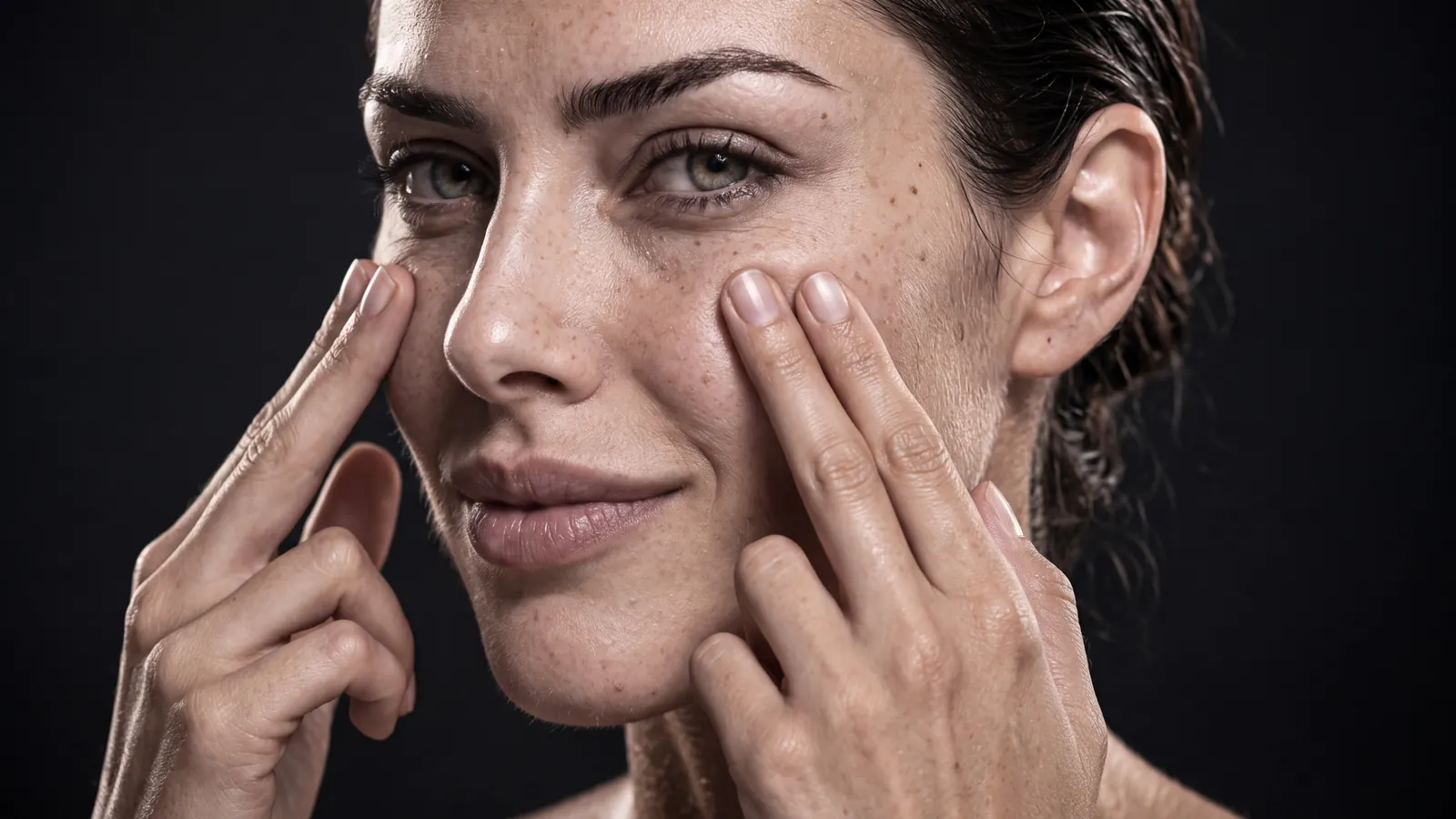
Start with your smile. Want to know which facial muscles control your smile? The main one is the zygomaticus major, which runs from the cheekbone to the corner of your mouth.
One-sided Cheek Lift
- Rest your fingertips lightly on both cheekbones.
- Smile on one side only, lifting that cheek up into your fingertips while the other side stays still.
- Hold, keeping your forehead relaxed and your jaw loose.
- Release, then switch sides.
- Finish with full smiles on both sides, watching in the mirror that both corners rise evenly.
One side usually lifts more easily on its own: your dominant side, the one that does more of the work every day. Add two extra reps on the side that lifts less, then finish with both together so you rehearse an even smile. Don't pull the skin: your fingertips are there to feel the lift, not to make it.
Next, your brows. If one tends to rise higher than the other, the mirror will show it.
Even brow raise
- Rest your fingertips lightly above both brows.
- Raise your brows against that light pressure, watching that both rise to the same height.
- Keep your eyes relaxed.
- Lower your brows slowly.
Keep each raise brief: the American Academy of Dermatology notes that repeatedly contracting the same muscles can etch permanent lines. If your eyelids or brows sit at different heights at rest, our article on what shapes your eyes and brows explains which parts are anatomy.
Jaw release
- Clench gently to find the jaw muscle in front of each ear, then let go.
- Rest your fingertips on both jaw muscles.
- Trace small, gentle circles on both sides, with your teeth apart and lips together.
- Stop with jaw pain, worsening clicking or dizziness.
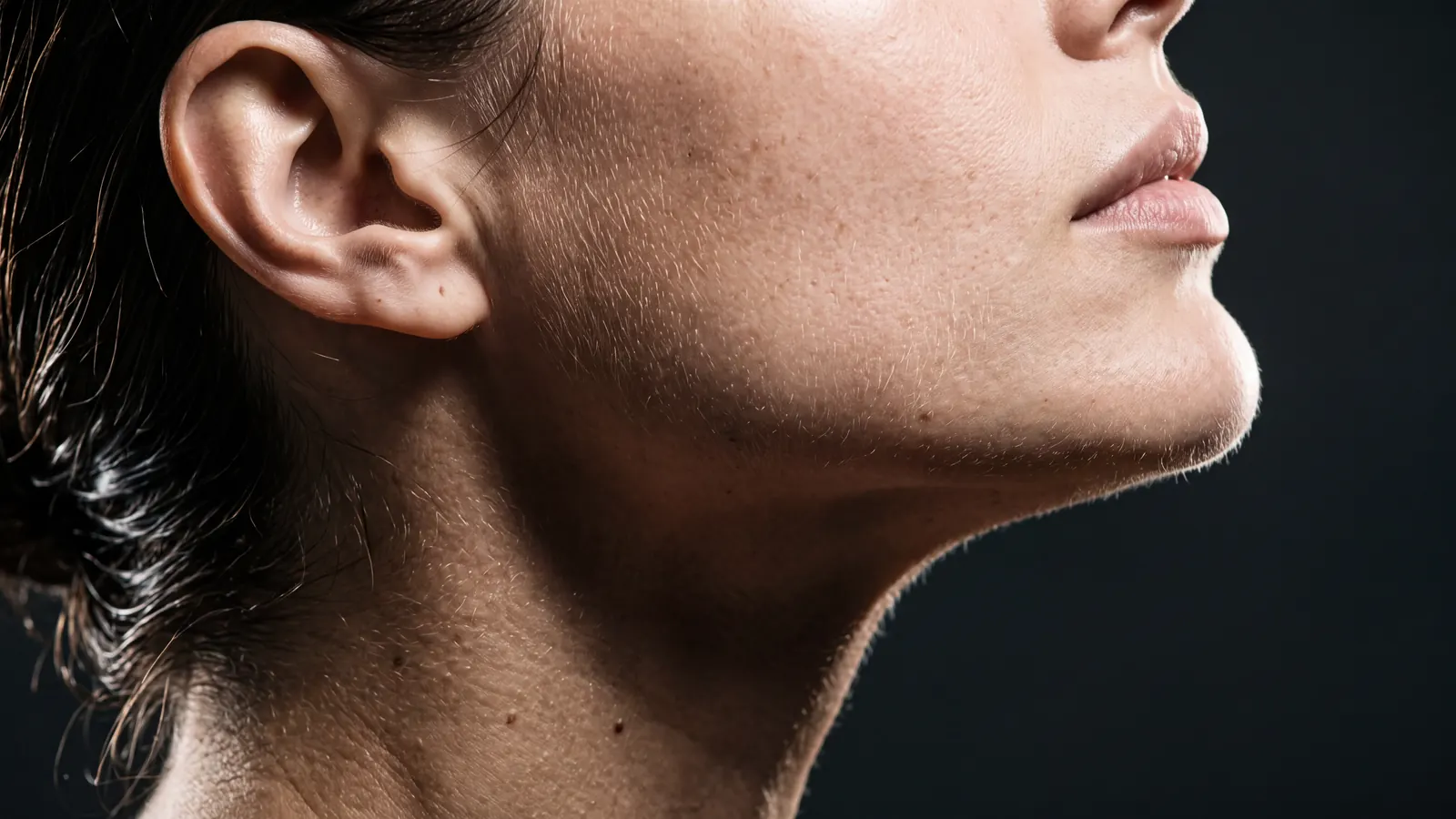
It lets the muscles you clench with relax evenly on both sides. If you clench or grind, a dentist can check for bruxism. Our article on jawline exercises covers the jaw muscles in more depth.
Finally, your head position. A habitual tilt makes your eyes, brows and mouth look uneven in every photo, even when your face is fine.
Level-head reset
- Sit tall in front of a mirror with your chin level.
- Lower your shoulders away from your ears.
- Check that your ears and shoulders sit level, then hold.
- Keep the range comfortable, and stop for neck pain, numbness or dizziness.
If you spend hours at a screen, our article on forward head posture has the full routine.
Can sleeping or chewing on one side cause asymmetry?
Yes. Sleeping on one side presses the same half of your face into the pillow every night, and chewing on one side works one set of jaw muscles harder at every meal. Over the years it shows: side sleepers have a lower upper eyelid on their favorite side, and twins have a larger chin opposite the side they chew on.
- Sleep side. People who favor one sleep side have a lower upper eyelid on that side. Side and stomach sleeping also compress and shear the face, leaving creases. Sleep on your back, or alternate sides, to share the load.
- Chewing side. In twins, the chin is larger on the side opposite their habitual chewing side, and function outweighs heredity. Chew on both sides. Missing teeth push people to one side: in 748 adults, one missing tooth more than doubled the odds of chewing on the other side (odds ratio 2.44). Get gaps and sore teeth seen by a dentist.
- Clenching and grinding. These load the jaw muscles and joints. For jaw-joint problems, the NIH's dental institute recommends cutting back on clenching and gum chewing.
- Leaning on one hand. Resting your face on the same hand presses on one side all day, the daytime version of sleeping on one side. Orthodontists list one-sided habits, from chewing to sleeping on the same side, among the causes of facial imbalance. Switch hands, or better, rest neither.
Treatments for structural asymmetry
When the difference is in bone or bite, the options are medical. Start with a dentist or orthodontist: they can tell whether your teeth, your jaw or both are involved, and refer you on if needed.
Orthodontics
- Best for
- Teeth and bite differences
- How long it lasts
- Long term, with retainers
- Main caution
- Months to years of treatment
Jaw (orthognathic) surgery
- Best for
- Large jaw or chin differences
- How long it lasts
- Permanent
- Main caution
- Major surgery; some uneven contour can remain
Dermal fillers
- Best for
- Disguising volume differences in the cheeks, chin or jaw
- How long it lasts
- Temporary, for absorbable fillers
- Main caution
- Injection into a blood vessel can cause tissue death, blindness or stroke
Botulinum toxin
- Best for
- A bulkier or overactive muscle on one side
- How long it lasts
- Wears off within months
- Main caution
- Needs repeat treatments
Orthodontic treatment, with or without jaw surgery, is the standard route for skeletal asymmetry. Fillers disguise smaller differences, and the FDA lists serious risks when filler enters a blood vessel, so choose a licensed, experienced provider and never buy fillers online. Botulinum toxin thins a bulky jaw muscle for a few months; in a trial in people who grind their teeth, the effect had faded by six months.
A 2025 review of non-surgical options, from fillers and thread lifts to energy-based devices, concluded that they enhance facial symmetry with immediate, visible results.
What does it cost? Anywhere from nothing, for photo setup and habits, through repeated filler or Botox appointments, to orthodontics and jaw surgery, the most expensive route. Before orthodontic treatment, the British Orthodontic Society advises a written plan after an in-person assessment, and a second opinion if you're unsure.
When is facial asymmetry an emergency?
When it appears suddenly. A face that droops on one side over minutes or hours can be a stroke, so call 911 (or your local emergency number) right away, even if you suspect Bell's palsy. Use the BE FAST check, note the time the symptoms started, and don't drive yourself to the hospital.
Bell's palsy is the most common cause of facial paralysis. It usually affects one side, appears suddenly and is at its worst about 48 hours after it starts. Most people recover fully within 3 to 6 months, but only a clinician can tell it apart from a stroke, so never wait it out at home.
New asymmetry that develops over weeks or months also deserves a doctor's visit, especially with a lump or swelling, jaw pain or locking, or a change in how your teeth fit together.
Frequently asked questions
How long does it take to fix an asymmetrical face?
It depends on the cause. A better photo setup works instantly, and swelling or sleep creases settle within days to weeks once your habits change. Muscle control builds over weeks of daily practice, and trained muscle starts to grow measurably after about three to four weeks. Bone and bite differences need orthodontics or surgery, which take months to years.
Can sleeping on one side make your face asymmetrical?
It can. Side sleeping presses the same half of your face into the pillow for hours every night, compressing and creasing it. People who favor one sleep side have a lower upper eyelid on that side, according to a study at an eye clinic. Sleeping on your back, or alternating sides, takes the pressure off.
Does chewing on one side cause facial asymmetry?
It works one side harder. Chewing on your favorite side at every meal loads that side's jaw muscles more, and in a study of 106 twin pairs, the chin was larger on the side opposite their habitual chewing side. Chew on both sides, and if a missing or sore tooth keeps you off one side, see a dentist.
Is facial asymmetry genetic?
Partly. In 1,800 orthodontic patients, the same pattern kept appearing regardless of sex, age or jaw type, a wider right half and a chin that leans left, which marks it as inherited. How you use your face counts too: in a twin study, chewing habits outweighed heredity in shaping the chin.
Does facial asymmetry go away with age?
No. In a 3D study of 191 people from infancy to age 88, asymmetry increased steadily with age in every third of the face, most in the middle and lower face. Bone remodels unevenly over the years, and soft tissue deflates and descends unevenly.
Do facial exercises work for asymmetry?
Yes, for the parts your muscles control. Tailored facial exercises improve facial function in people recovering from facial palsy, and a 2024 review of 21 studies of facial exercise programs reported more facial symmetry among the improvements. Daily mirror practice trains your smile and brows to move evenly; bone and bite differences need an orthodontist.
Sources
- Linden OE, et al. The relationship between age and facial asymmetry. Plastic and Reconstructive Surgery, 2018. 3D photos of 191 volunteers, from infants to age 88.
- Haraguchi S, et al. Asymmetry of the face in orthodontic patients. Angle Orthodontist, 2008. 1,800 orthodontic patients in Japan.
- Thiesen G, et al. Facial asymmetry: a current review. Dental Press Journal of Orthodontics, 2015. Review of causes, diagnosis and treatment.
- de Runz A, et al. Female plastic surgery patients prefer mirror-reversed photographs of themselves: a prospective study. Journal of Plastic, Reconstructive & Aesthetic Surgery, 2016. 214 women; 73% preferred their mirror-reversed photo.
- Ward B, et al. Nasal distortion in short-distance photographs: the selfie effect. JAMA Facial Plastic Surgery, 2018. How camera distance changes facial proportions.
- Tran C, et al. The effect of sleep position preference on eyelid and eyebrow symmetry. Ophthalmic Plastic and Reconstructive Surgery, 2022. Sleep side and upper eyelid position.
- Heikkinen EV, et al. Facial asymmetry and chewing sides in twins. Acta Odontologica Scandinavica, 2022. 106 twin pairs.
- Heikkinen EV, et al. Chewing side preference, facial asymmetry and related factors in the Northern Finland Birth Cohort 1986. Acta Odontologica Scandinavica, 2024. 748 adults with 3D face scans.
- Levrini L, et al. Myofunctional speech therapy for facial rejuvenation and orofacial function improvement: a systematic review. Journal of Functional Morphology and Kinesiology, 2024. 21 studies of facial exercise programs.
- Teixeira LJ, et al. Physical therapy for Bell's palsy (idiopathic facial paralysis). Cochrane Database of Systematic Reviews, 2011. 12 trials, 872 participants.
- Centers for Disease Control and Prevention. Signs and symptoms of stroke. The BE FAST check.
- MedlinePlus (US National Library of Medicine). Bell's palsy.
This article is educational and is not medical advice.